How 'Frankenstein' Did the Near Impossible And Swept The Craft Categories At the Oscars
News

News
The film achieved the design trifecta, taking home the awards for Best Costume Design, Best Production Design, and Best Makeup and Hairstyling at the 2026 Oscars.
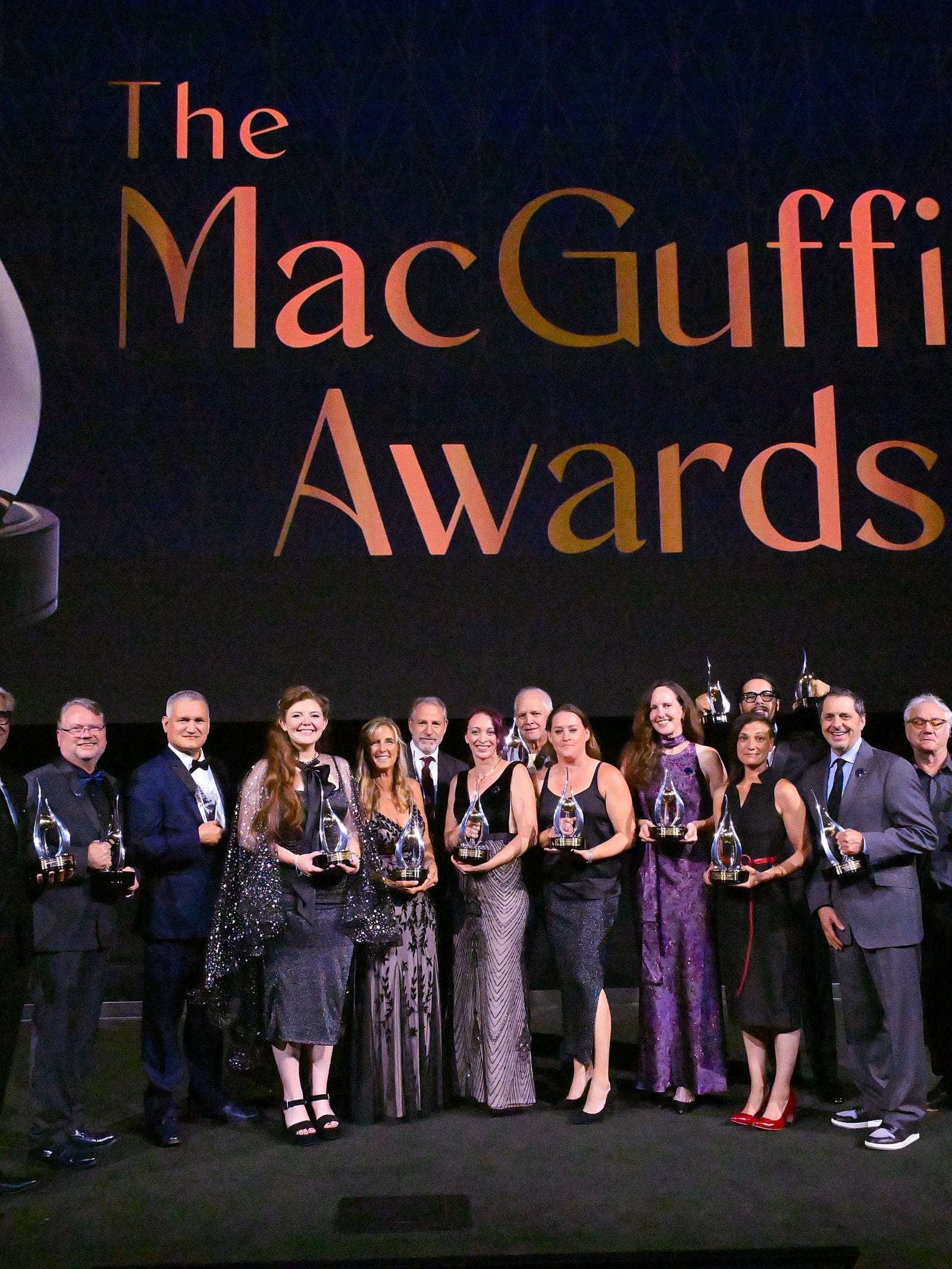
“Frankenstein” won Best Costume Design, Best Production Design, and Best Makeup and Hairstyling at the Academy Awards on Sunday,, opens in new tab making it the third-most awarded film of the night after “One Battle After Another” and “Sinners, opens in new tab.” Although Guillermo del Toro’s visionary adaptation of the Gothic classic missed out on headline prizes like Best Picture and Best Supporting Actor for Jacob Elordi, its success in these three categories tells a far more compelling award season story—one that underscores the value of championing moviemaking crafts and building a fully realized cinematic world.
In Oscar history, craft sweeps are not a regular occurrence. Since the makeup and hairstyling category was established in 1981, opens in new tab, just a handful of films have achieved what “Frankenstein” has. The first was “Amadeus” (1984), the epic period piece about the life of Mozart, followed two decades later by “The Lord of the Rings: The Return of the King” (2004), which brought every corner of Middle-earth to life in astounding detail. The meticulously stylized “The Grand Budapest Hotel” (2014) then received the accolades, and a year later, the tactile, wasteland world of “Mad Max: Fury Road” (2015) repeated the sweep. The most recent film to take home all three awards was “Poor Things” (2023), a surrealist and visually sumptuous coming-of-age story (which coincidentally was also inspired by Mary Shelley’s seminal novel of reanimation).
.jpg&w=3840&q=85)

Guillermo del Toro on the set of "Frankenstein."
Netflix
The three categories may be judged by AMPAS voters separately, but together they are responsible for how a film comes alive on screen. Production design constructs the physical world that characters inhabit. Costume design signals identity through color, fabric, and silhouette. Makeup and hairstyling shape an actor’s appearance, transforming them into characters both familiar and new—or in the case of Elordi’s character in “Frankenstein,” a combination of the two. It’s in this balance between familiarity and invention that the film finds its visual identity. It’s not a straight period piece, but like many of del Toro’s films, exists on a plane where magical realism takes precedent, allowing the creative teams working behind the scenes to build something truly singular.
When veteran prosthetics master and the film’s creature designer Mike Hill—who shares the Best Makeup and Hairstyling win with makeup department head Jordan Samuels and hair designer Cliona Furey—spoke to The Set Set last year, opens in new tab, he emphasised how reimagining the monster was no easy task. “When you're designing a character like this," Hill said, “it is very difficult because everyone has preconceived ideas of what it should look like.” He said that both he and del Toro “kind of have a crush” on Boris Karloff’s iconic version of the monster, but knew they needed to take a new approach, one that reset people’s perception of the Creature. “A lot of interpretations since Karloff’s look like a road accident,” Hill told us. “I wanted to make it clear that if you saw my character, you would know a man made this. It's very, very handmade.”


Jacob Elordi in the makeup chair for "Frankenstein". His look required 42 prosthetics. Photo: Netflix
Netflix


Jacob Elordi in "Frankenstein". Photo: Netflix
Netflix
Jacob Elordi in the makeup chair for "Frankenstein". His look required 42 prosthetics. Photo: Netflix
Netflix
Jacob Elordi in "Frankenstein". Photo: Netflix
Netflix
Hill found himself mirroring the work of the film’s mad scientist as he painstakingly and precisely conceptualized the design of the Creature that would serve as the film’s centrepiece. The makeup consisted of 42 overlapping prosthetic pieces applied to Elordi more than 50 times in sessions that took upwards of 10 hours in the makeup trailer, and Hill wouldn’t have it any other way. “If you’d introduced digital effects to this Creature, you’d modernise it instantly,” Hill explained. “And the moment the audience notices that, you’ve destroyed it.”
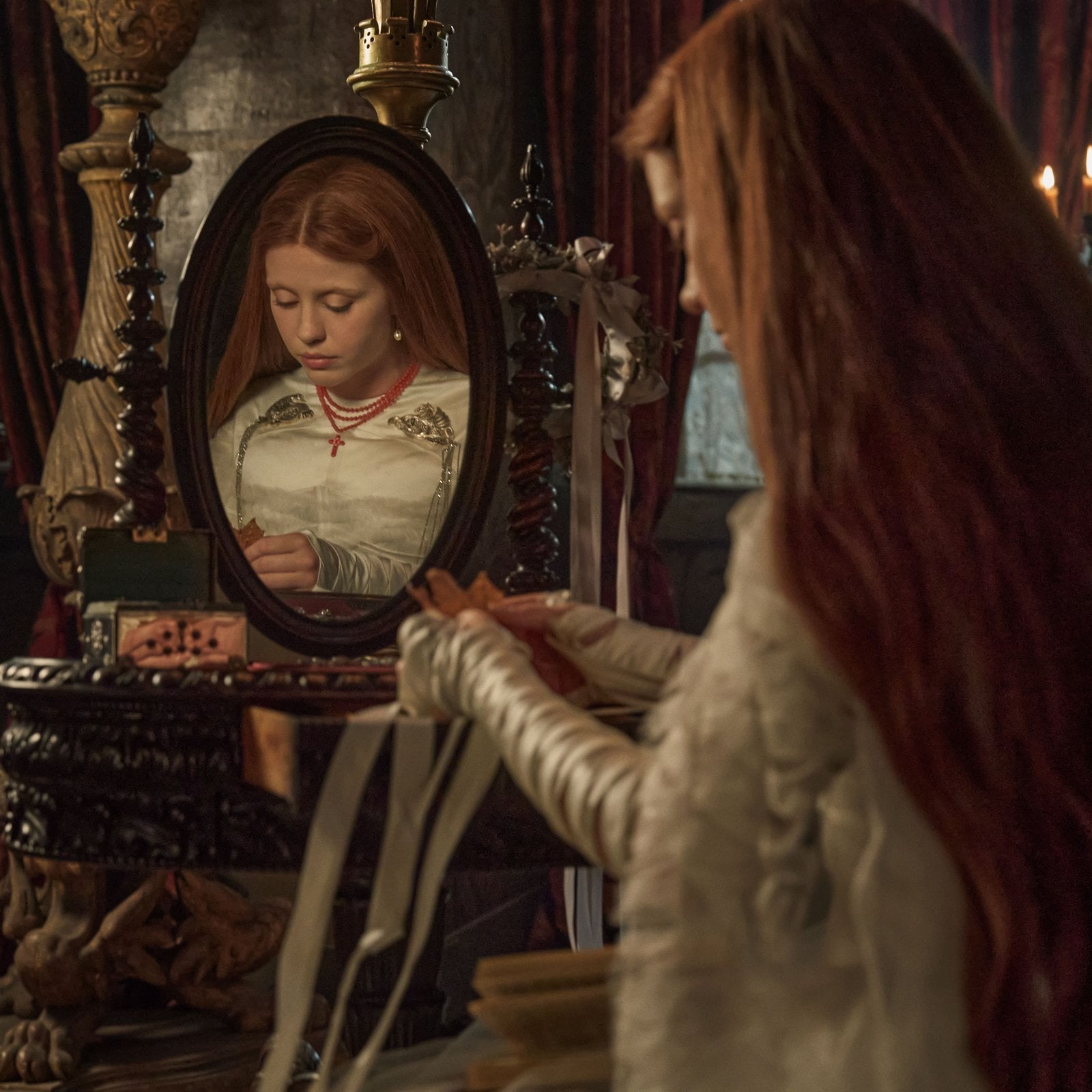
In Kate Hawley’s celebrated costumes, the Victorian era is given a Gothic edge. Early on, a decision was made not to hew too closely to an accurate nineteenth-century aesthetic. Instead, Hawley’s wardrobes for Mia Goth combine conventional fabrics and accessories with otherworldly touches—a gown featuring a hypnotic print created from X-rays of female anatomy, another with fluttering ribbon-wrapped sleeves that recall the Creature’s bandages and her own fascination with insects. “Guillermo wanted Elizabeth to feel very ephemeral,” Hawley, who reunited with the director following collaborations on “Pacific Rim” and “Crimson Peak,” told The Set Set., opens in new tab “You almost can't capture her as a character, and she reflects many different stages of women.”
.jpg&w=3840&q=85)

Mia Goth in "Frankenstein".
Netflix
That idea is reinforced in the film’s dual casting, with Goth playing both Victor’s mother Claire and his romantic interest Elizabeth, something that in turn inspired Hawley to incorporate a color story in the film. At the beginning of the film, we see Claire in head-to-toe red with a billowing veil shortly before she is laid to rest with her face encircled in an arresting rose-carved coffin lid. The color becomes a symbolic thread throughout the movie, with Victor going on to adopt the crimson shade in his choice of glove and neckerchief, and Elizabeth herself appearing in an all-red look when Victor confesses his feelings for her (her bonnet lined with blooming rosettes becomes a haunting nod to Claire)—all before Hawley brings the palette back to its origins when, as Elizabeth lies dying in the tragic penultimate act, blood blooms over her ghostly white wedding dress until she is enshrouded in the arterial shade.
Completing the unified artistic vision is Tamara Deverell, the film’s production designer, who shares her Academy Award win with set decorator Shane Vieau. Together, they fleshed out the texture and terrain of the film's vibrant 1850s world. Deverell—who has worked with del Toro since his English-language debut, “Mimic,” in 1996—said she and del Toro "communicate through drawings and references; it’s a shared visual language that makes collaboration fluid and instinctive."
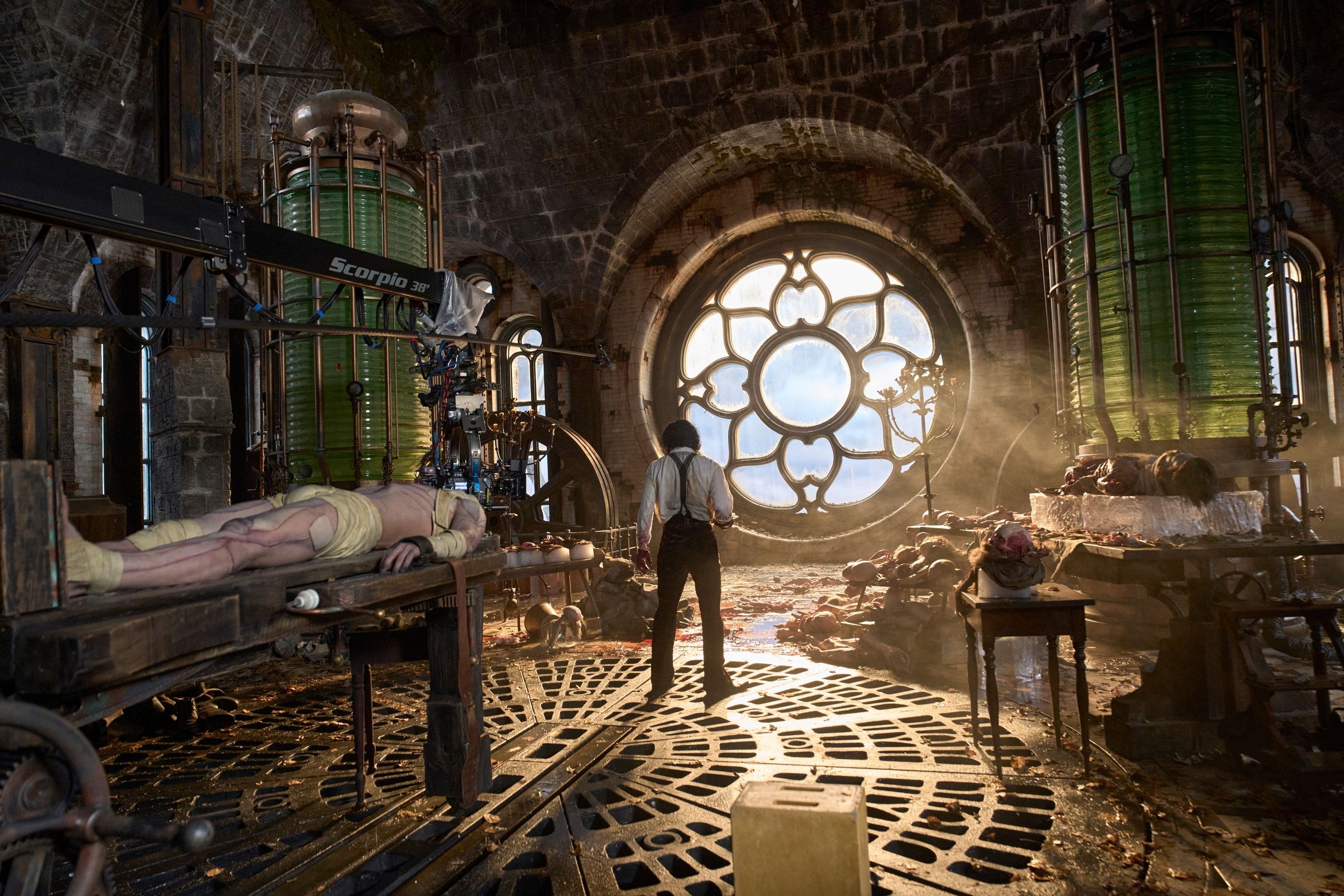

Oscar Isaac in "Frankenstein".
Netflix
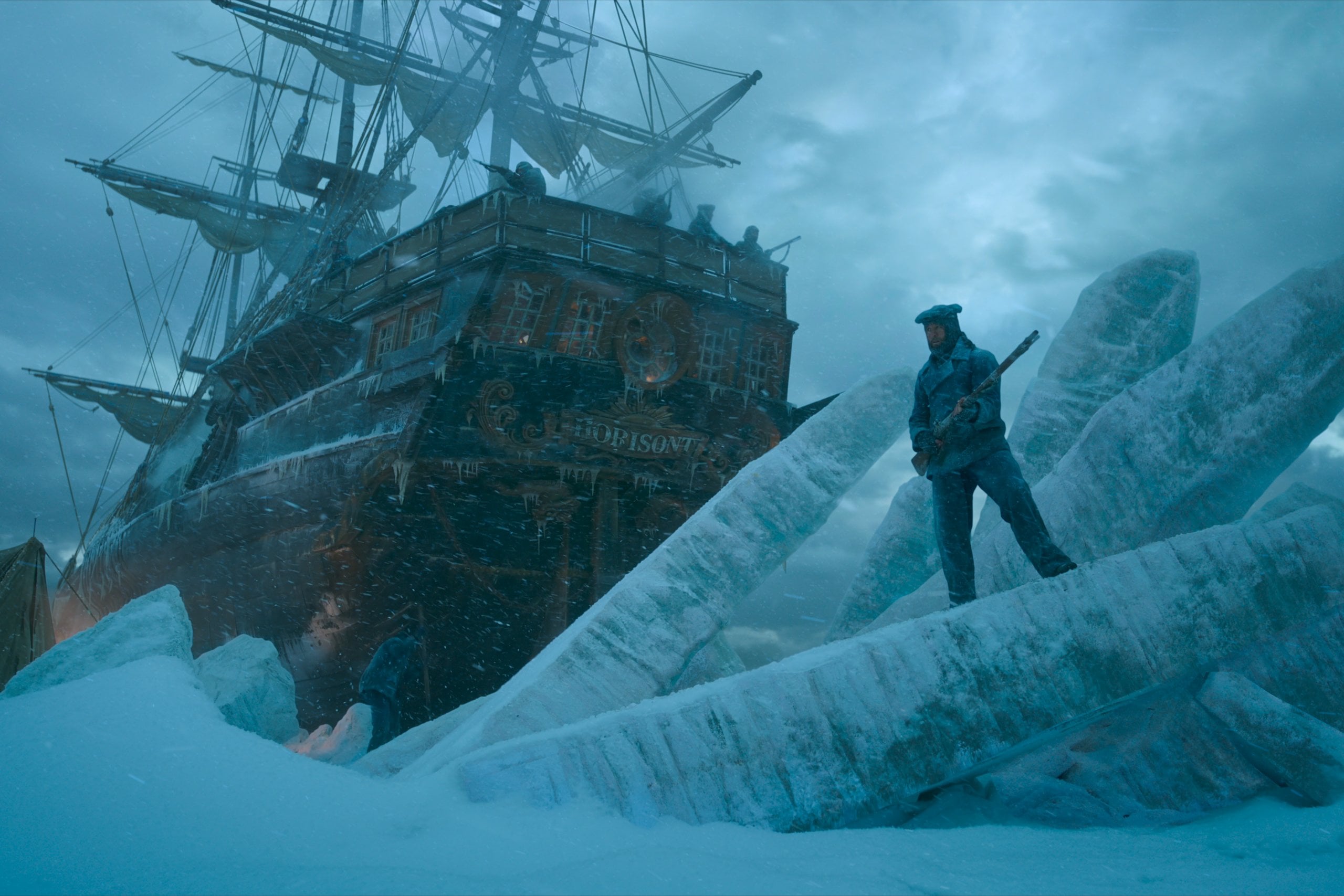

The shipwreck in "Frankenstein."
Netflix
Oscar Isaac in "Frankenstein".
Netflix
The shipwreck in "Frankenstein."
Netflix
Across the 112 locations in Scotland, England, and Toronto, not a single thing was shot against a green screen. Instead, breathtakingly detailed sets were constructed from scratch, including her pièce de resistance, a 130-foot frozen-in-place ship. The set, which bookends the film, was constructed in a sprawling Toronto parking lot. For builds like the interior of Victor’s lab and the rural cottage, del Toro asked Deverell to create every corner, resulting in a 360-degree spectacle that gave cinematographer Dan Laustsen the freedom to shoot from any angle. “Our goal was to create something deeply handcrafted—'for humans, by humans,' as Guillermo describes it,” Deverell told us after her win. "Every frame was carefully built by hand. Even our visual effects, though digital, were approached with a handmade ethos—crafted by artists working frame by frame. The lighting design relied on a primary single-source approach, enhanced with practicals, to evoke a heightened yet truthful world. The result is imagery reminiscent of hand-painted works from the 17th and 18th centuries."
It’s clear that for del Toro and his collaborators, the magic of cinema doesn’t lie in deceiving audiences with illusions and sleight of hand but in the pursuit of something real. There are no half-built sets, character transformations that rely on VFX, or costumes designed for convenience. The filmmaker has long argued that films that look beautiful are not merely eye candy but eye protein: nourishing, substantive, and essential. With all that considered, it's no surprise that "Frankenstein," his magnum opus that he has been working towards his whole career, has achieved the rare feat of sweeping the Academy’s design categories. The film is a convergence of craft at the highest level.