
Kate Hawley On Mia Goth’s Hauntingly Symbolic ‘Frankenstein’ Wardrobe
Fashion
From blood cells to boned corsets, the costume designer reveals all the easter eggs hidden in Goths' Victorian-era gowns.

Symbolism runs deep in Guillermo del Toro’s “Frankenstein,” where striking shapes, evocative details, and vibrant color-coding fill the screen. Scintillating clues reside in every millimeter of the visionary auteur’s faithful adaptation of Mary Shelley’s 1818 gothic novel—especially in alluring, enigmatic Elizabeth Harlander’s (Mia Goth) Victorian wardrobe.
“Guillermo wanted Elizabeth to feel very ephemeral,” says costume designer Kate Hawley, who has reunited with the Oscar-winning director following collaborations on “Pacific Rim” and “Crimson Peak.” “You almost can't capture her as a character, and she reflects many different stages of women.”
Elizabeth's "Ideal" Blue Dress
Fresh from an elite convent school, Elizabeth demonstrates a sharp interest in botany and entomology—namely beetles, which signify life, death, and rebirth in many cultures. She immediately captivates Dr. Victor Frankenstein (Oscar Isaac), a brilliant, narcissistic scientist fixated on conquering death and reanimating life—and the older brother of her fiancé, William (Felix Kammerer).
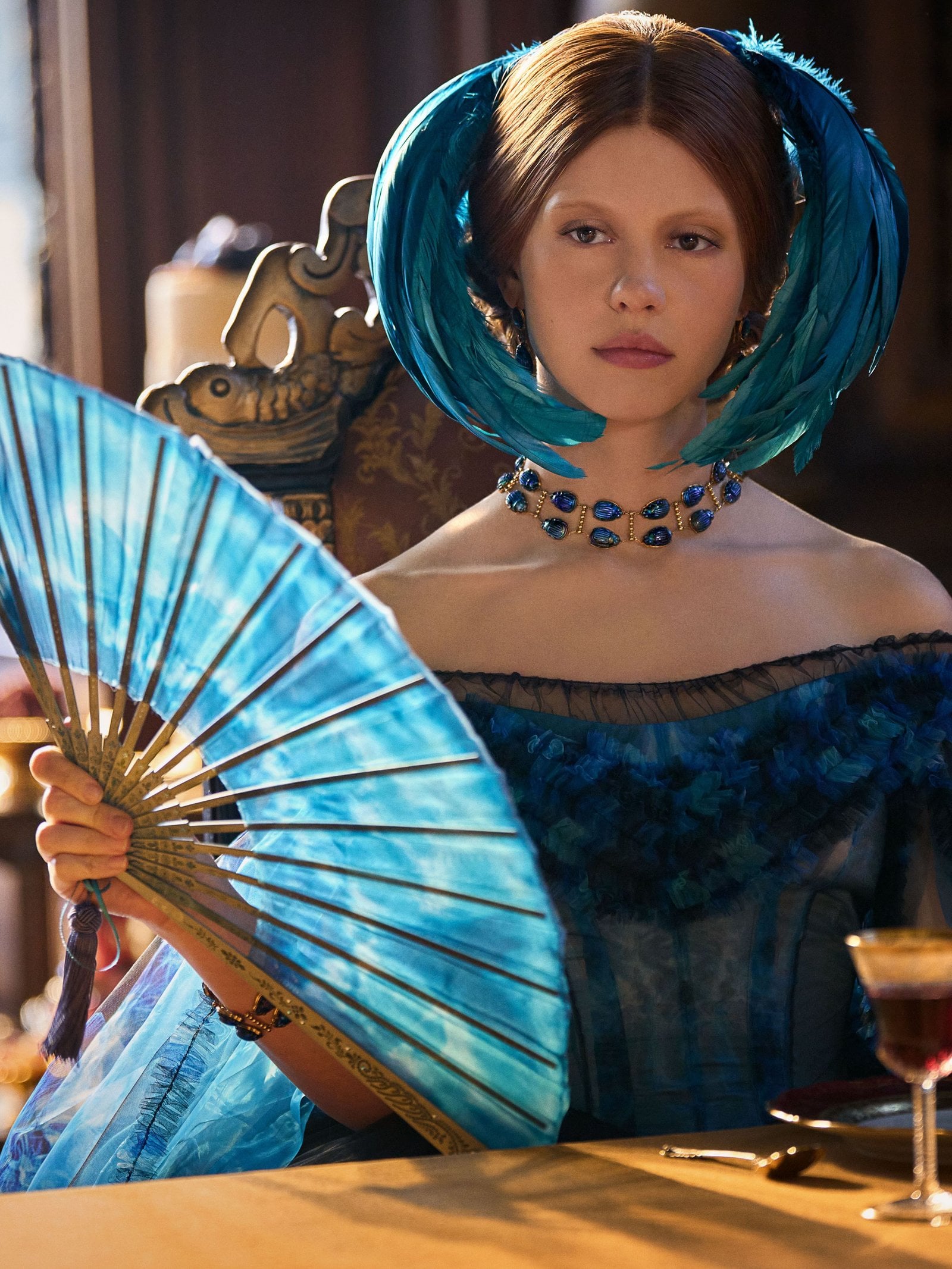
Like an apparition, Elizabeth floats into the room in a stunning peacock-blue dress. The cascading watercolor patterns, on layers upon layers of gossamer organza, almost take on a life of their own. “I call it the ‘X-ray dress,’” says Hawley, who created the hypnotic abstract print by blending imagery of female anatomy X-rays and Victorian damask patterns. “Victor sees the image of a ‘perfect’ woman,” says Hawley. “An Angel. A Madonna.”
Elizabeth’s face is framed at the center of a circle formed by curved feather headpieces, and underscored by an early-1900s Louis Comfort Tiffany necklace gleaming with carnelian, beetle-shaped glass gemstones. The spherical effect suggests Medusa, the mythical snake-haired enchantress, whose gaze instantaneously turns men to stone. Round shapes representing the circle of life are also seen consistently throughout Del Toro fare, like “Crimson Peak” and “The Shape of Water.”
Mia Goth as Elizabeth Lavenza in "Frankenstein." Photo: Ken Woroner/Netflix.
Ken Woroner/Netflix
“We see it reflected in the mirrors [by production designer Tamara Deverell],” says Hawley. “Everyone's reflecting the image of themselves.“

Mia Goth as Elizabeth Lavenza in "Frankenstein." Photo: Ken Woroner/Netflix.
Ken Woroner/Netflix
The Fiery Medusa Gown
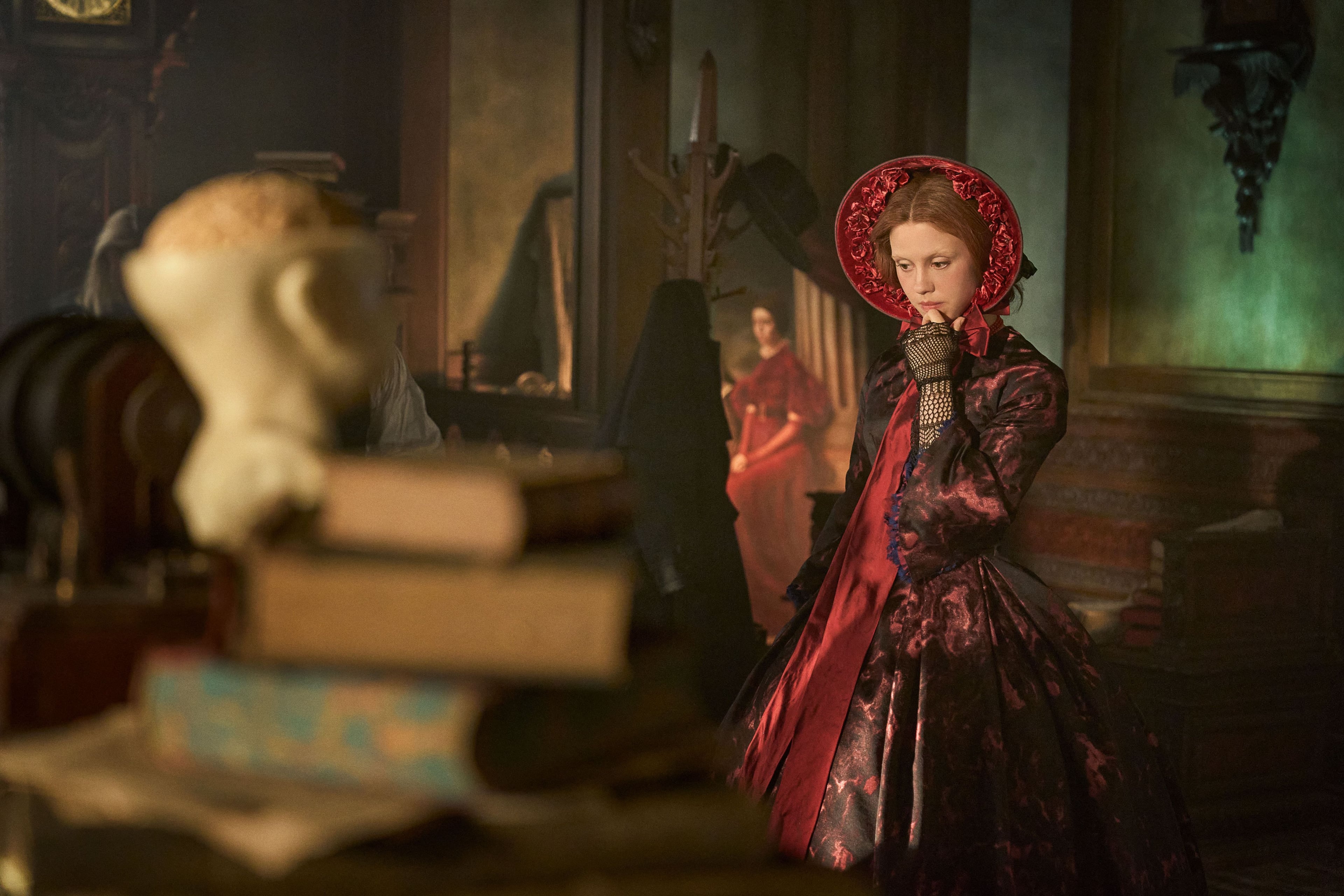
As her wedding to William approaches, Elizabeth feels drawn to Victor through their shared passion for the natural world. She arrives at his apartment, which is more a mad scientist’s lab populated by dead body parts waiting to be assembled into one reanimated human. A red dress bonnet, lined with blooming rosettes, encircles Elizabeth’s face again and amplifies her perplexed state. “I love that Elizabeth's quite kooky,” says Hawley.
The red floral appliqués also thread back to the rose-carved coffin lid of Victor’s mother, Claire (also played by Goth), seen in flashbacks. “All of those languages are iterated and repeated throughout,” says Hawley. “Every time you see [Elizabeth], it's almost like a fleeting, other version of a woman.”
At the center of Elizabeth’s beloved red rosary cross sits a scarab, the beetle revered by the ancient Egyptians as a symbol of rebirth and regeneration. For the Tiffany & Co. collaboration necklace, Hawley took inspiration from Louis Comfort Tiffany designer Meta K. Overbeck’s Art Deco-influenced illustrations. “Everything was Elizabeth’s version of nature and her religion,” says Hawley, who imagined that Elizabeth practiced philosopher and Christian clergyman William Paley’s “Natural Theology,” which reasons that aspects of the natural world demonstrate God's existence. “That crosses with her all the way through the whole movie.”
Elizabeth’s black-and-red gown shimmers ominously, like uncontrolled flames that foreshadow explosive events to come. “It was the idea of blood and fire, and the layers of flayed skin on all the anatomical models on all the tables,” says Hawley, also referring to the lace-up detail on the back of Elizabeth’s dress that’s revealed as she bends over to inspect Victor’s work. “Her [back] echoes the flayed creature’s spine on the table.”

Mia Goth as Elizabeth Lavenza in "Frankenstein." Photo: Ken Woroner/Netflix.
Ken Woroner/Netflix

Felix Kammerer and Mia Goth in "Frankenstein." Photo: Ken Woroner/Netflix.
Ken Woroner/Netflix
The Enthralling Emerald Ensemble
With a Medusa head sculpture looming over his water tower laboratory, Victor brings the unnamed Creature (Jacob Elordi) to life, but loses his moral compass in the process. As Victor struggles with the newborn-like Creature, Elizabeth and William arrive in the tower’s gorgeously crumbling foyer, boasting a grand circular staircase and porthole windows.
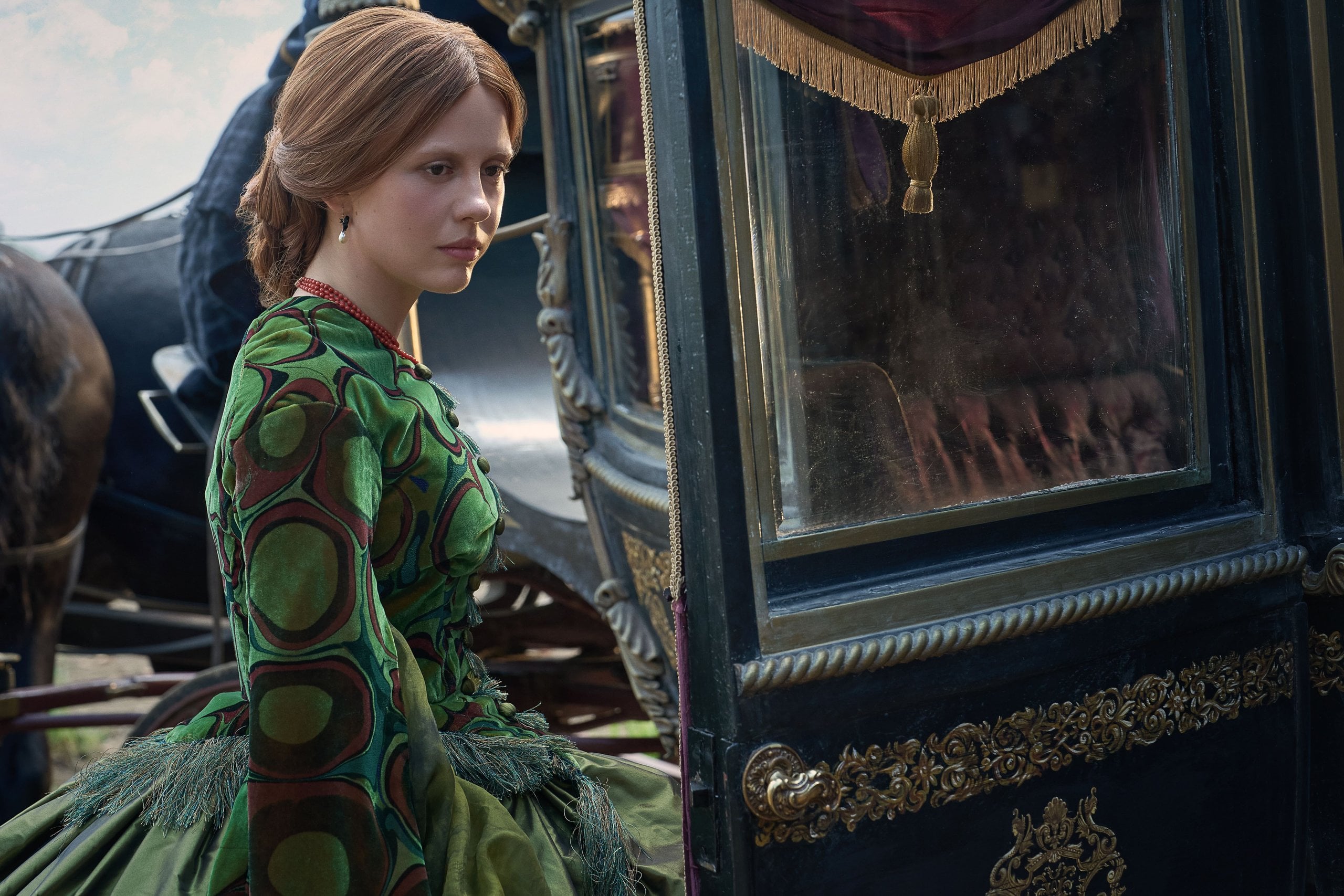
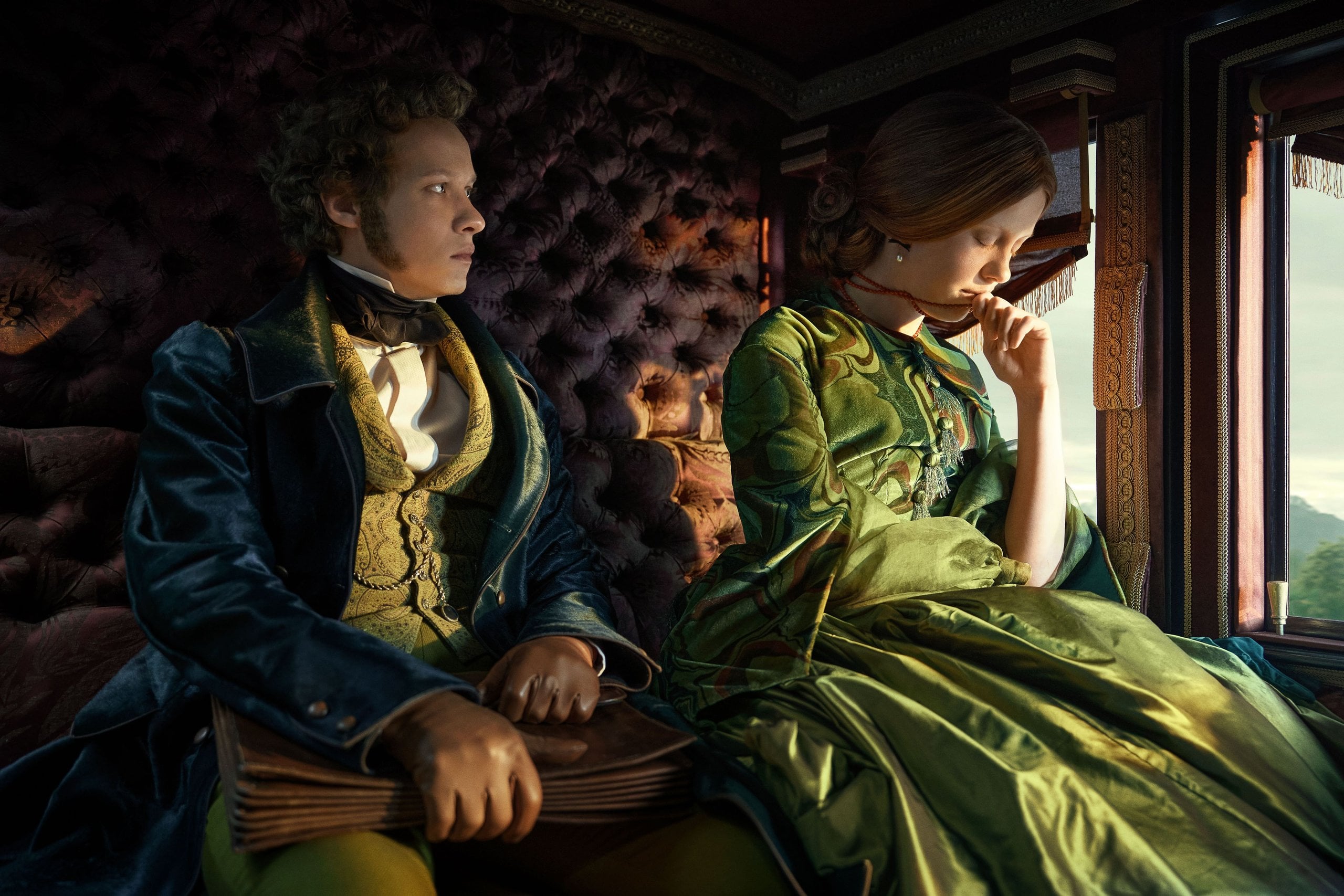
Elizabeth travels there wearing an acid-green bonnet adorned with a vibrant violet bow. “It's almost like the head is disembodied from the rest of the character—just floating like the Medusa on the [lab] wall,” says Hawley. “It’s the same thing again.” In a coordinating sculptural chartreuse gown and a bell-sleeved velvet basque jacket, Elizabeth senses the Creature. She finds him chained down by Victor in the bowels of the water tower. “We used color upon color to suggest the darker tones of the world,” says Hawley.
She explains that the swirl-like graphics on Elizabeth’s jacket evoke “blood cells, anatomy, beetles, wings” seen under a microscope. The iridescent green tassels lining the bodice and waistline also refer to opalescent Tiffany Favrile glass patterns. “We wove a lot of the fabrics and my team printed the little jacket with marbling in-house,” says Hawley, adding that some of Elizabeth’s dresses required nearly 200 feet of fabric for the copious layers.
The Creature is immediately mesmerized by Elizabeth’s kindness and curiosity—the polar opposite of Victor’s seething frustration—and by her otherworldly, luminescent dress, which creates a holographic effect as she moves toward him. “The transparencies and layers allowed the idea of skin to create quite a painterly feel and a more dream-like quality with Elizabeth, evoking all her different tones,” says Hawley. “When the Creature pulls off her gloves, it echoes Victor pulling off his red gloves [in his lab] earlier in the film.”
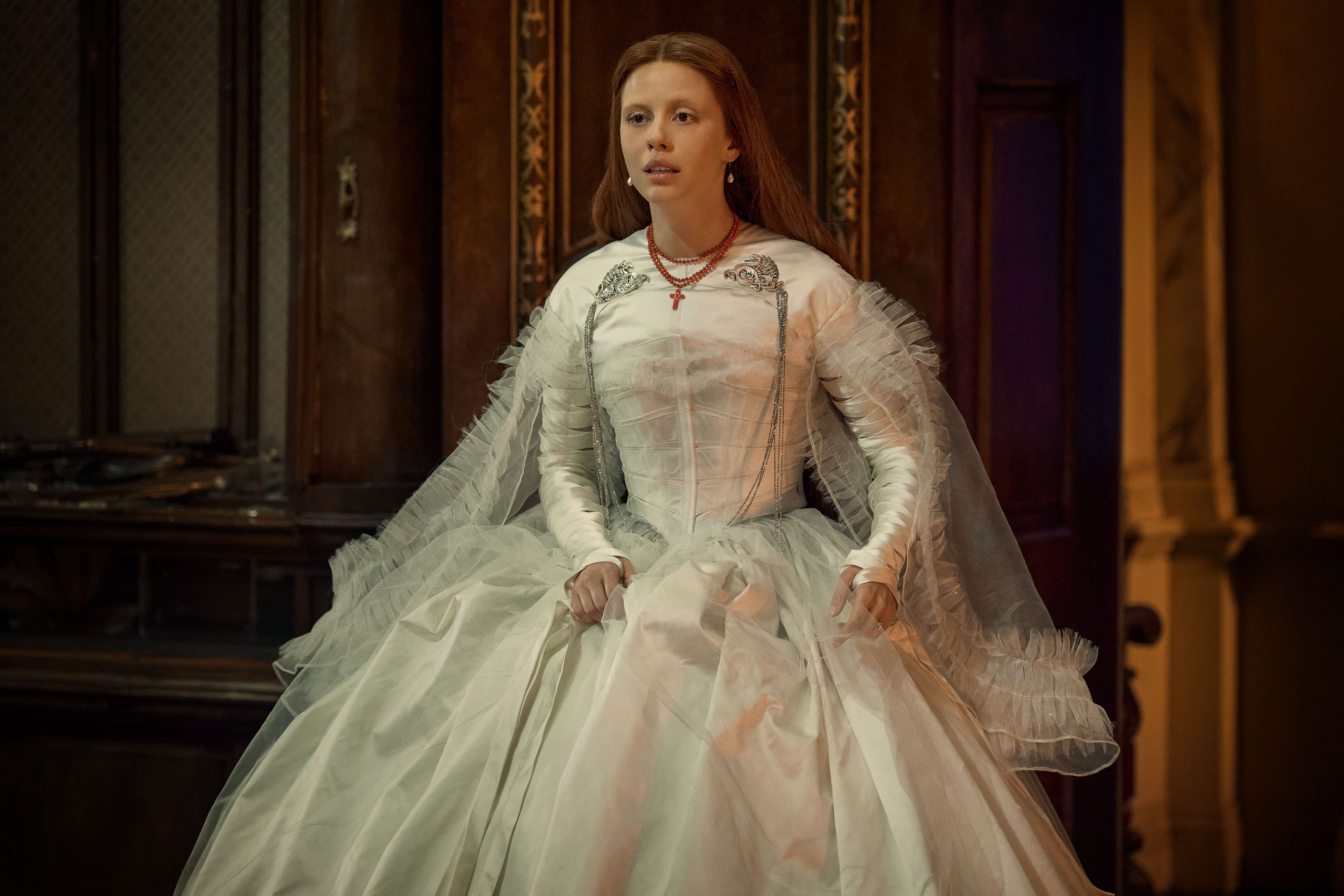

Mia Goth in her wedding dress in "Frankenstein." Photo: Ken Woroner/Netflix.
Ken Woroner/Netflix
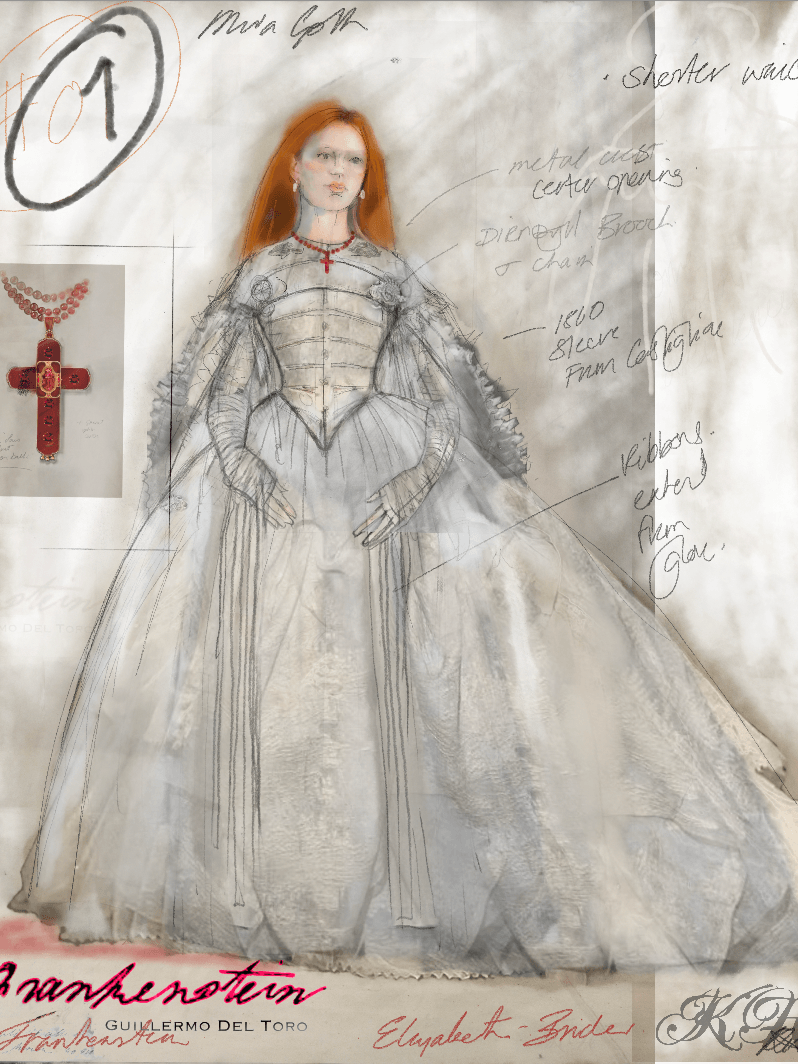

Costume designer Kate Hawley's sketch for Mia Goth's "Frankenstein" wedding dress. Photo courtesy of Kate Hawley.
Kate Hawley
The Doomed Wedding Dress
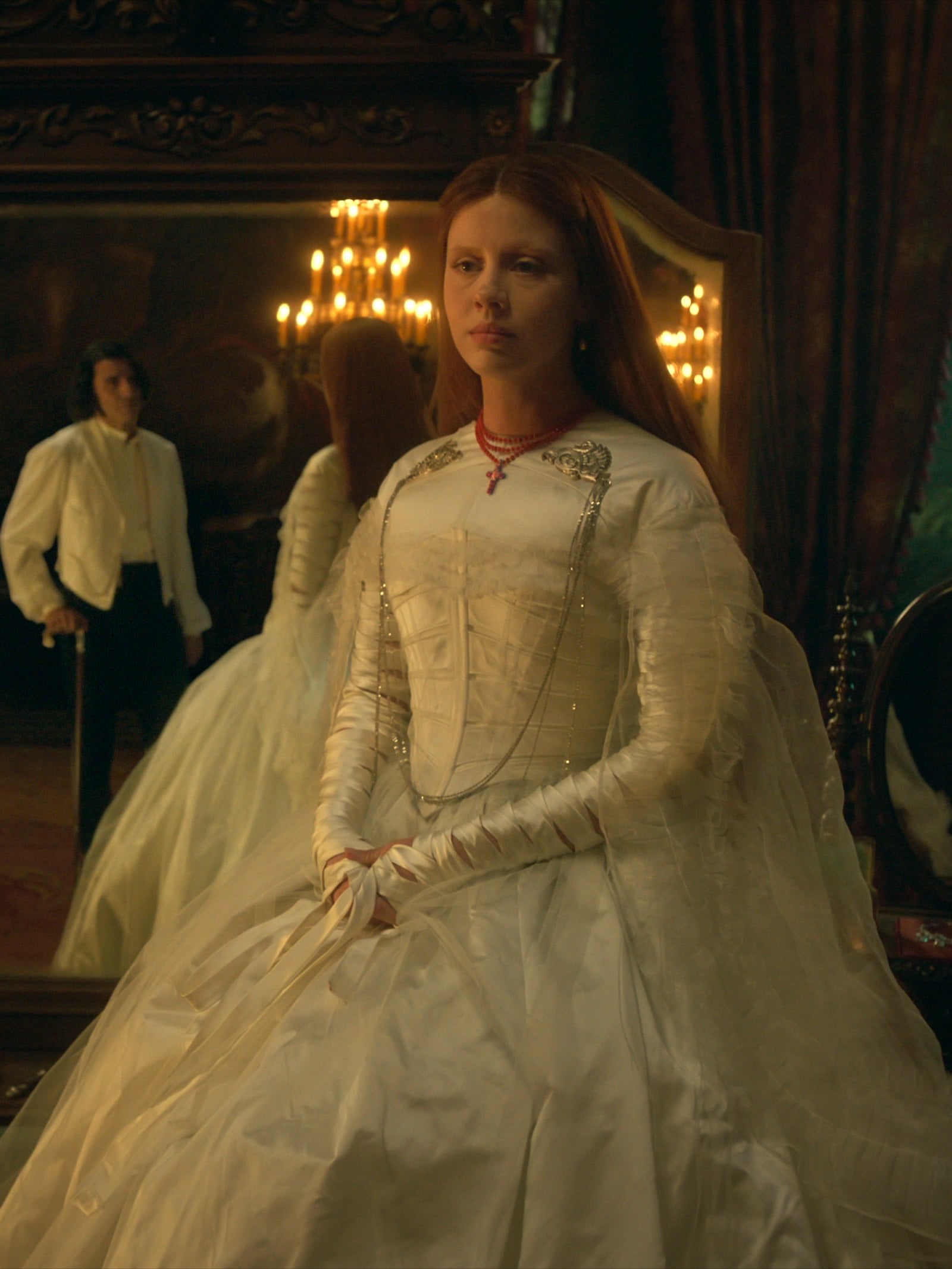
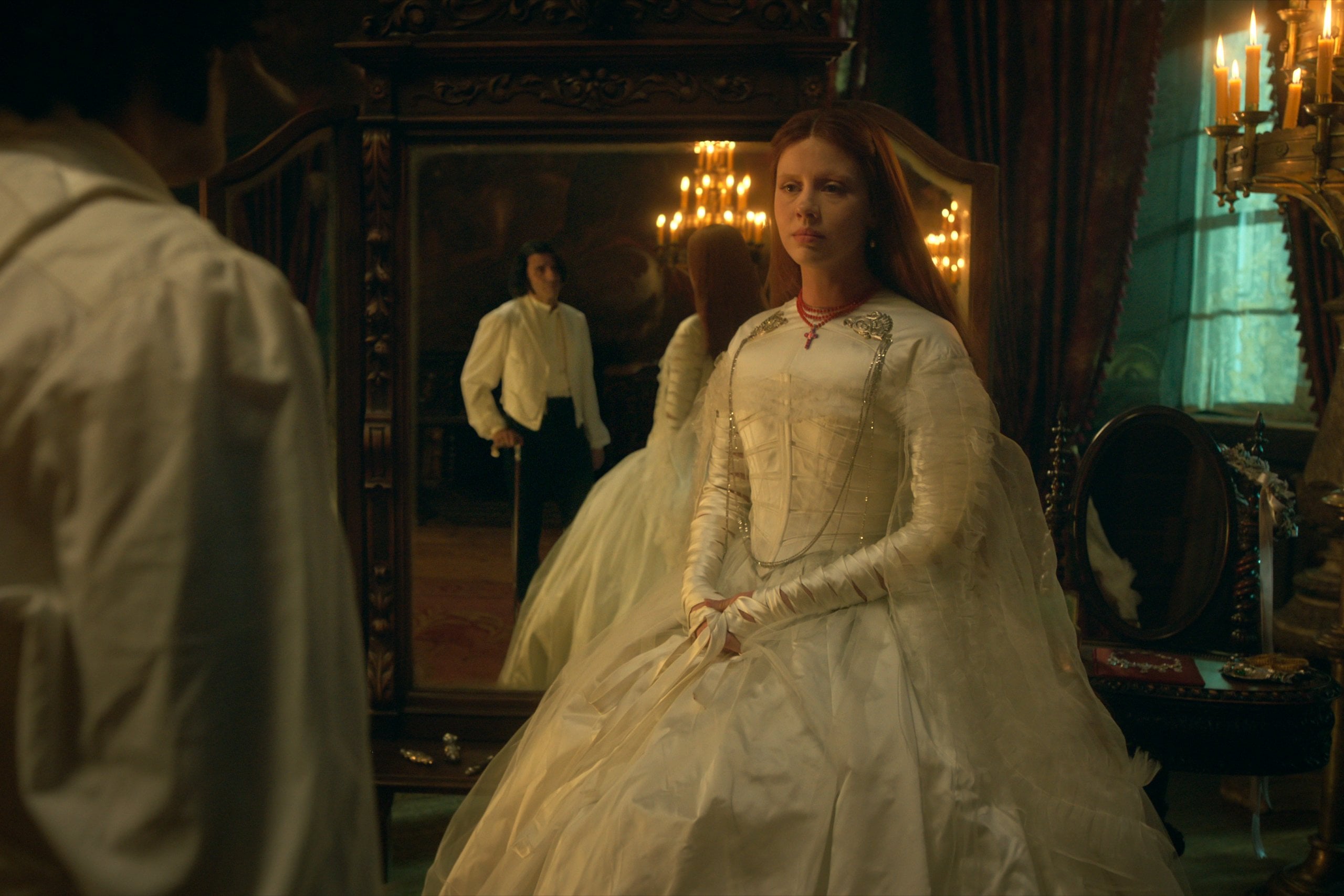
Searching for his origin story, the Creature tracks down Victor on his brother’s wedding day and finds the pensive Elizabeth waiting in her white bridal gown. “It’s definitely an homage to one of Guillermo's favorite films, ‘Bride of Frankenstein,’” says Hawley. “We built that period-correct dress [with the idea of] taking the inside and putting it on the outside.”
The diaphanous layers of Elizabeth’s gown serve as a culmination of the story’s recurring symbolism and her connection to the Creature. The bodice’s exposed-boning corset implies a rib cage, delicate organza ruffles flutter like insect wings, and her silk-satin ribbon-wrapped sleeves recall the reanimated Creature’s bandages.
Elizabeth’s wedding dress also circles back to Victor. A lace-up spine decorates the back, while double snake brooches, made in collaboration with Tiffany & Co., nod to the old money Frankenstein family crest on her bodice. She wears the gown with a red scarab rosary, which again feels foreboding, like a blood stain on white. Even off-body, the gown carried an uncanny quality. “We put it on the stand once, and we were actually undoing all the layers, and the back looked just like a flayed skin," Hawley recalls.
As Elizabeth lies dying in the tragic penultimate act, blood slowly seeps into her ghostly tiers of gossamer organza, harking back to Victor’s earlier memory of Claire in head-to-toe crimson with a billowing veil obscuring her face. “Guillermo wanted the idea that it was a visceral cloud of blood coming from her head,” says Hawley. “Then, to see it echoed at the end, you end where you began.”