How Kazu Hiro Made Tom Cruise Look Nothing Like Himself—Yet Still Recognizably Tom Cruise—in ‘Digger’
Beauty


Beauty
The Oscar-winning prosthetic makeup artist talks through sculpting interchangeable facial features and creating a 50-pound silicone belly for the eccentric oil tycoon at the center of “Digger,” as well as streamlining the six-hour application process.
Warning: Spoilers for “Digger” below.
Director and co-writer Alejandro Iñárritu gave prosthetics designer Kazu Hiro a somewhat paradoxical directive in transforming Tom Cruise into the titular eccentric, larger-than-life oil magnate who wreaks global ecological havoc in "Digger." "Alejandro told me, ‘I don't want him to look like Tom Cruise, but like Tom Cruise at the same time,’” Hiro recalls. Iñárritu, however, did share a wealth of reference imagery to convey the essence of Digger Rockwell. “He had lots of reference photographs of oil tycoons, from the past and the present, but everybody looks so different,” says Hiro, who then immersed himself in visual and video research of industry titans and executives. “To try to figure out what kind of lifestyle they have and how they transition as they age.”
The big reveal in the movie—again, spoiler alert—also complicated the design and concepting process. That's because Cruise’s character turns out to be an actor named Curtis portraying the oil baron in a theater production memorializing the apocalyptic event. “Is this supposed to be makeup or the real person?” says Hiro, articulating a key question in his design process. “Alejandro told me, ‘OK, yes, it’s a stage play, but not really.’”
Distilling all the research and directives, Hiro began his distinctive, exacting design process—famed in the industry for working with actors’ existing features rather than completely changing them. Hiro won his first Oscar (of two) in 2018 for transforming Gary Oldman into Winston Churchill in “The Darkest Hour” and earned his sixth nomination last year for Dwayne Johnson’s portrayal of MMA fighter Mark Kerr in “The Smashing Machine.”
“Alejandro wanted him bald with thin hair,” says Hiro, who began sculpting onto a headcast of Cruise. He then presented Iñárritu with interchangeable features to reconfigure and refine before landing on the final look. “It’s just trial and error because Alejandro likes to change the idea,” says Hiro. “[For example], I made three options of noses to switch around with different foreheads and cheeks.” Ultimately, Hiro created a contoured silicone cap that sits atop a plastic bald cap, along with separate forehead, nose, and cheek pieces, plus a lower lip and chin connected to a thicker neck, a wig, and eyebrows.
Perspiration patterns and levels vary by actor, affecting both prosthetics design and the efficacy of the glue. Hiro often needs to adjust the design and application process during filming, as he did for Johnson’s high-intensity fight scenes in “The Smashing Machine.” Cruise, celebrated for doing his own extreme stunts and bringing expressive physicality to his roles, is also known to perspire heavily—even without prosthetics.
“It’s hard to tell until you try it out for a few days and apply [the prosthetics]. Then we start to see what kind of reaction he has or how he sweats,” says Hiro. “The first design pretty much covered [his entire face and neck]. So the second one, I cut down a lot to expose his cheeks and back of the neck [to allow for perspiration].” The production also brought a cooling machine on set for Cruise.
Iñárritu further envisioned Digger—living a life of excess—as heavier-set, with a protruding belly exposed during a shirtless dance sequence in the tycoon’s vast walk-in closet. Originally, Hiro explains, Digger was written as 76 years old, but Iñárritu later brought the character closer to Cruise’s actual age of 64. So Hiro studied reference photos of men in their mid-60s to sculpt a separate body prosthetic that connects seamlessly to the neck piece of the facial ones.


Tom Cruise in "Digger".
Warner Bros.
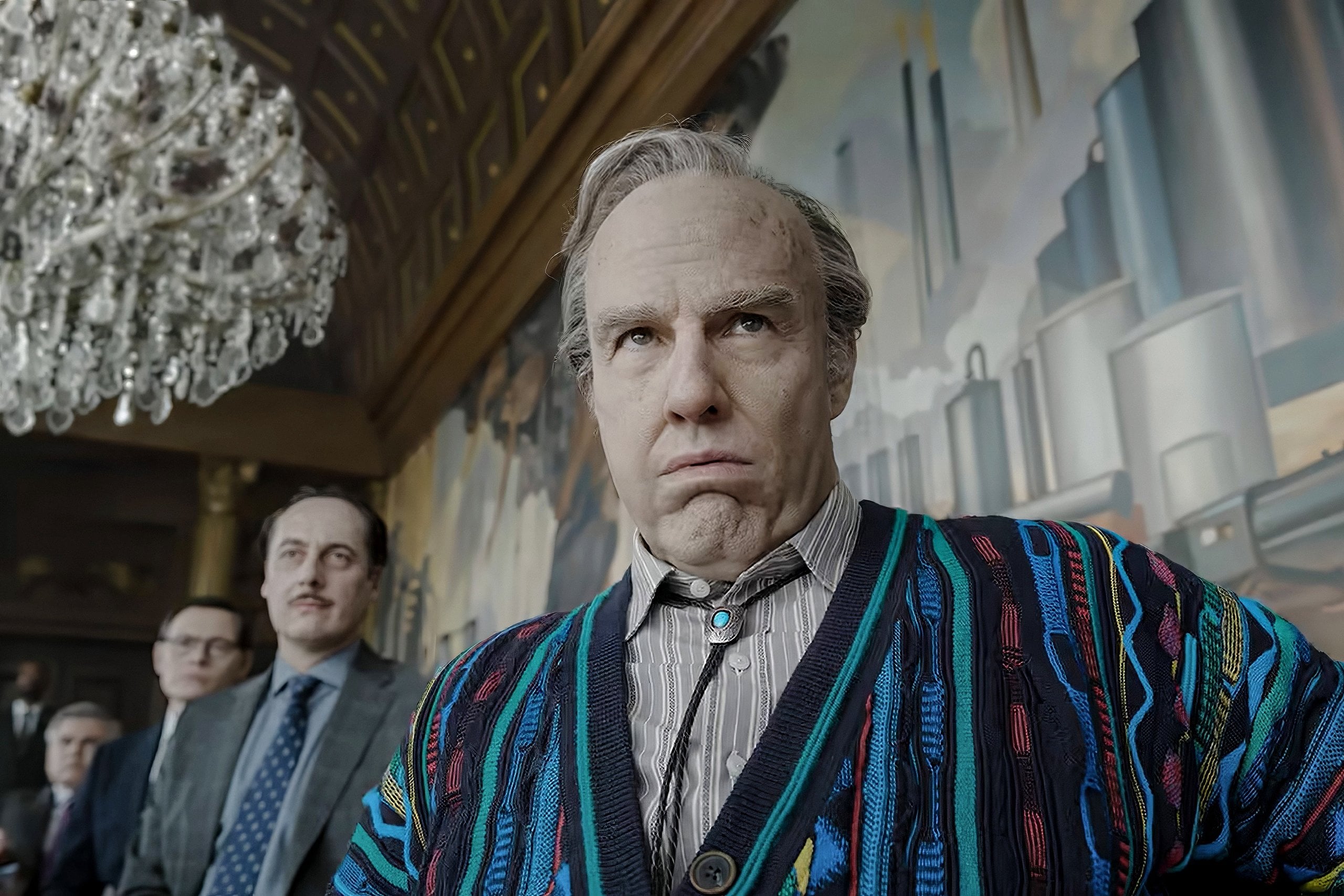

Tom Cruise in "Digger".
Warner Bros.
Tom Cruise in "Digger".
Warner Bros.
Tom Cruise in "Digger".
Warner Bros.
“It’s also a practical reason to make it easier for [Cruise] to go through [the applications] every day instead of one big piece glued on him,” says Hiro, who also created lighter-weight body padding in the same shape for Cruise to wear under his costumes, designed by Jacqueline West.
But Cruise found that the 10-pound padding didn’t feel as authentic to his performance as wearing the 40-to-50-pound prosthetic belly. “He put the padding on and said, ‘I cannot feel the weight. I want to wear the silicone prosthetic every day,” says Hiro, with his eyes widening. “I said, ‘It's gonna be heavy and hot every day.’ He said, ‘No. I'm an athlete and I'm trained, so I will be fine.’ So we quickly made the bodysuits out of the silicone prosthetic, and he wore it every day.”
Along with Cruise’s, Hiro also designed and created two additional prosthetics: the 90-year-old version of Digger, whose scenes were cut from the ending, and Dr. Nirav Ghanesh (an also-transformed Riz Ahmed), an environmental scientist and the film’s largely ignored voice of reason. Per Iñárritu’s vision for the “balding” and tightly wound Dr. Ghanesh, Hiro designed a widened nose, a receding hairline, and a bald spot for Ahmed. Hair and makeup designer Alessandro Bertolazzi created the wig of thinning, untamed waves. “It’s much simpler compared to Tom's, but I think that was effective,” says Hiro.
Ahead of the “Digger” premiere, Cruise made headlines for recounting how he used a stopwatch to “drill and practice” cutting the six-hour makeup and prosthetics application down to just one hour. “I always struggle with every time an actor gives an interview and talks about how long the makeup took. Because many actors say it’s a longer day because they want to show how much they suffered in the chair,” says Hiro.
Cruise wanted to wear the full prosthetics during rehearsals, which began six weeks before filming. Hiro explains that the first makeup test, which involved a more complex application with the wig, “took less than five hours,” with the time steadily decreasing to two and a half hours—a turnaround generally considered quite efficient. “Then Tom requested to do it in an hour,” says Hiro. “It’s not impossible because you just slap on everything and get done with it. But that's not what we want to do, right? But I understand the actor’s situation. They have to work eight hours or more after the application.”
Hiro deftly adjusted his process, also in coordination with his team. But his efficiency, which directors value in keeping pace with demanding filming schedules, is also a consideration from the earliest stages of his designs. “I'm thinking about that even while I'm sculpting it. So the important part is balance, too,” says Hiro. “What makes sense to do every day? So you know that was that.”