‘Sunrise on the Reaping’ Reimagines The Style of 'The Hunger Games’ Through a ’70s Lens
Fashion
TSS Creative
Bina Daigeler

Fashion
TSS Creative
Bina Daigeler
Costume designer Bina Daigeler breaks down dressing the characters of "The Hunger Games" prequel for both spectacle and survival.
Joining an established film franchise for a new story can be something of a balancing act for a costume designer. For Bina Daigeler, who stepped into the world of “The Hunger Games” for “Sunrise on the Reaping,” her mission was to bring a distinctive new era of Panem to life while keeping the franchise’s visual identity intact. “When you join such a big project, you always feel a lot of responsibility because people have expectations,” Daigeler tells The Set Set. “You have to be in the flavor and taste of the director, the producers, but you also have the fan community, and the goal is to make something that makes sense with what’s come before, but that is also new and fresh.”
Set 24 years before the original series of films and following fan-favorite character, Haymitch Abernathy (played by Woody Harrelson in the original franchise and here by newcomer Joseph Zada) as he is plunged into the brutality of being a District 12 tribute for the 50th Games, “Sunrise on the Reaping” offered Daigeler and the other department heads the opportunity to not strictly adhere to the visual language established in the previous films, which which led them to land on the decision to approach the film through the lens of the late 1960s and early 1970s. “That was the base, but we created our own world,” Daigeler says. “We made it our own fantasy version of the 1960s and ’70s. It would be easy to do too much, but for Francis [Lawrence, the film's director] it was very important that we were not too literally in the ’70s.”
The film begins in District 12 on the morning of the Reaping, which is also, unfortunately, Haymitch’s birthday. A mining community where resources are scarce, and fashion is considerably less important than practicality. Daigeler dressed the residents of District 12 in muted shades, while still embedding the ‘70s sensibility through silhouettes. “You see as they gather for the Reaping, everyone is dressed in grey and black, even when they are dressing up,” Daigeler says.


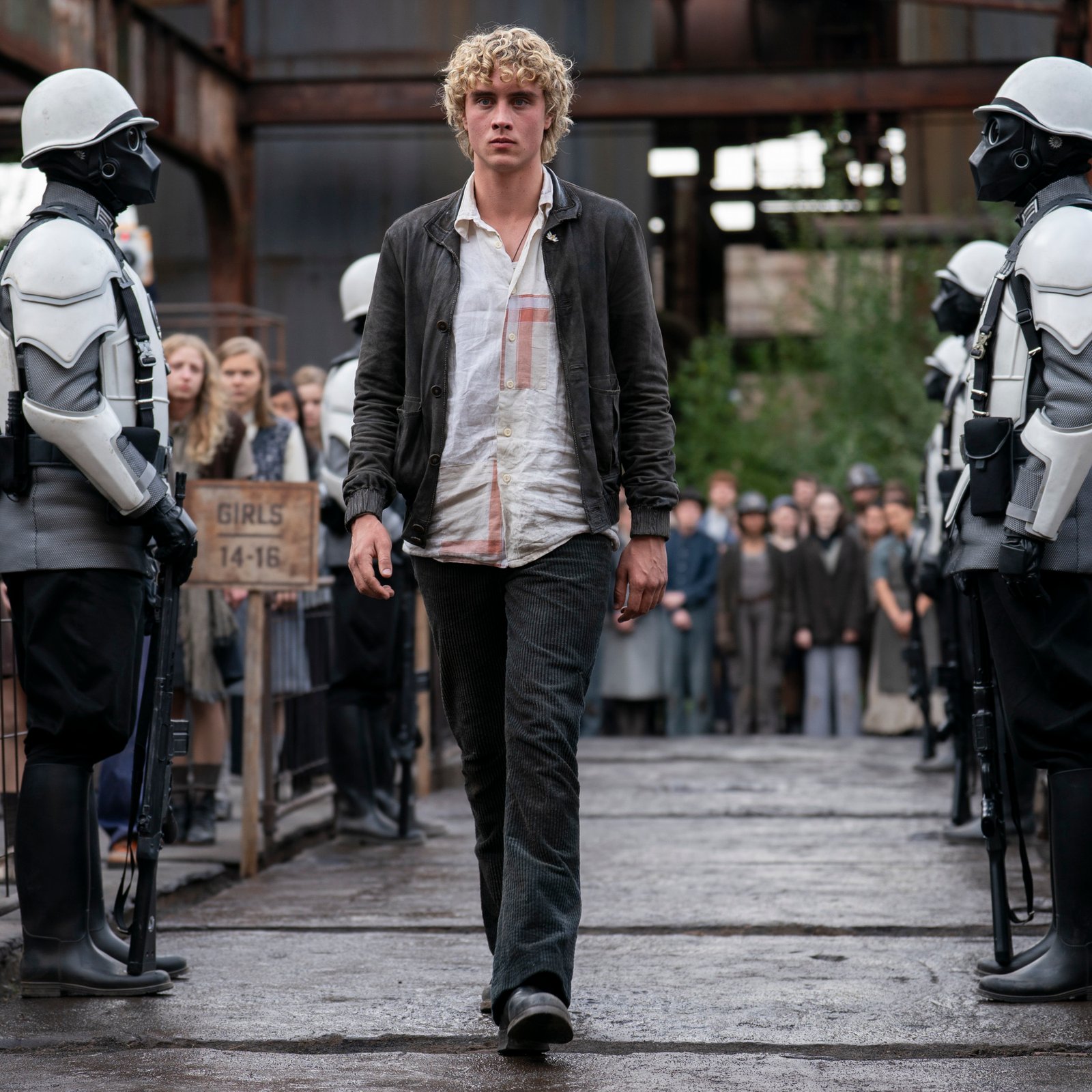
Joseph Zada in "The Hunger Games: Sunrise on the Reaping."
Lionsgate
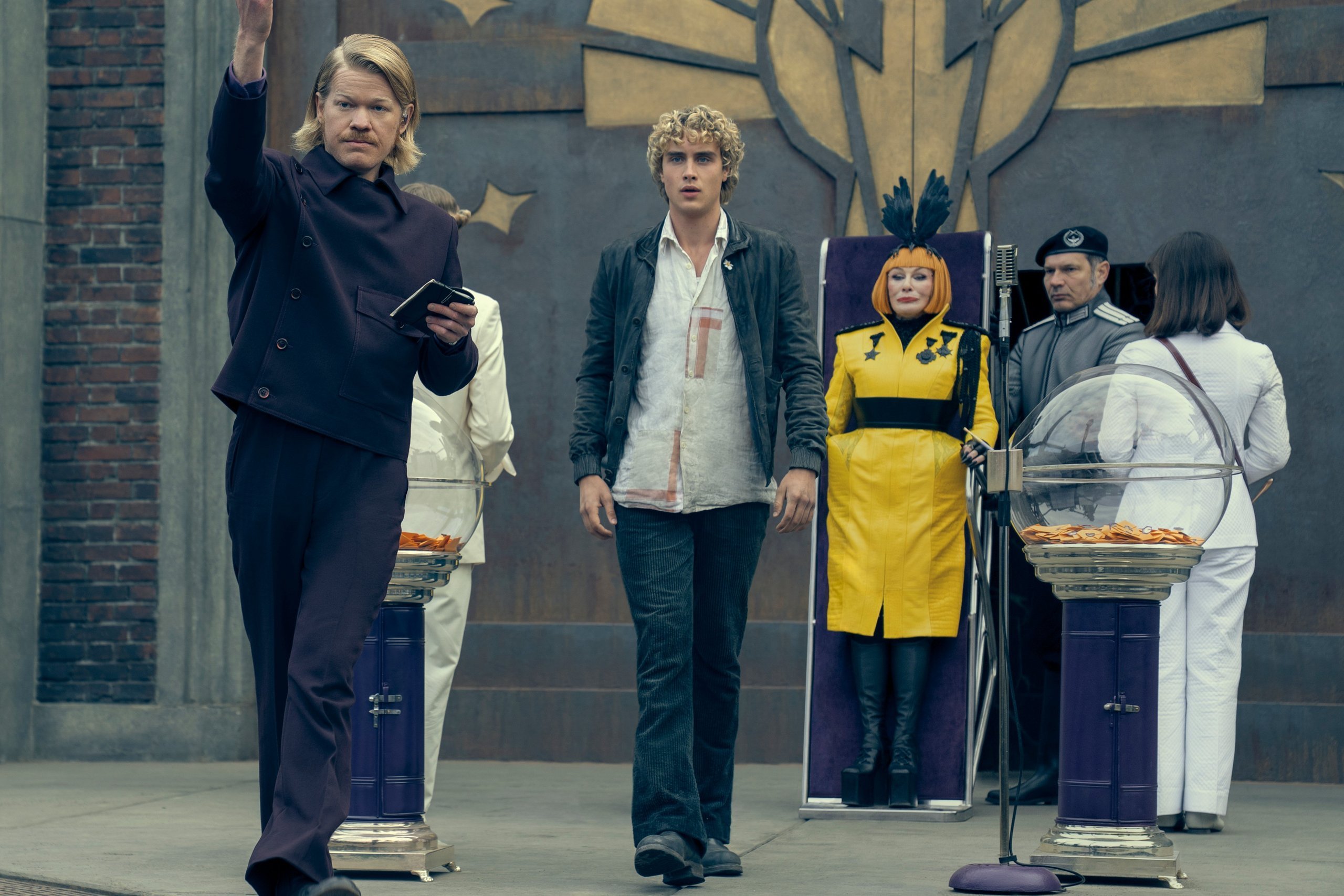

Jesse Plemons, Joseph Zada, and Glenn Close in "The Hunger Games: Sunrise on the Reaping."
Lionsgate
Joseph Zada in "The Hunger Games: Sunrise on the Reaping."
Lionsgate
Jesse Plemons, Joseph Zada, and Glenn Close in "The Hunger Games: Sunrise on the Reaping."
Lionsgate
Haymitch’s Reaping day outfit consists of dark-wash pants and a faded black jacket, worn over a white linen shirt that has had its holes patched with faded handkerchiefs by his mother. For Daigeler, the garment was an opportunity to communicate the family's circumstances and the love behind such a small gesture. “She wanted to give her son something for that special day,” she says. “As everybody gets dressed up for the Reaping, I thought, OK, she doesn't really have anything in the house apart from this old, beautiful white linen shirt that she’s mended. It’s the most emotional costume of the film.”
Haymitch's wardrobe undergoes a dramatic transformation when he arrives in the Capitol along with the other tributes. For his pre-Games interview with Caesar Flickerman (played here by Kieran Culkin; Stanley Tucci originated the role), he wears a sleek all-black suit that plays into his rascal persona as he charms the audience by joking about selling moonshine to District 12 Peacekeepers. Later, when he returns to Caesar’s stage for his televised victory interview, he trembles in a likewise well-cut double-breasted, dazzling white suit that is not only a direct contrast to his earlier black suit, but also to his increasingly dirtied all-white arena wear that the audience has seen him wear for a large portion of the movie.
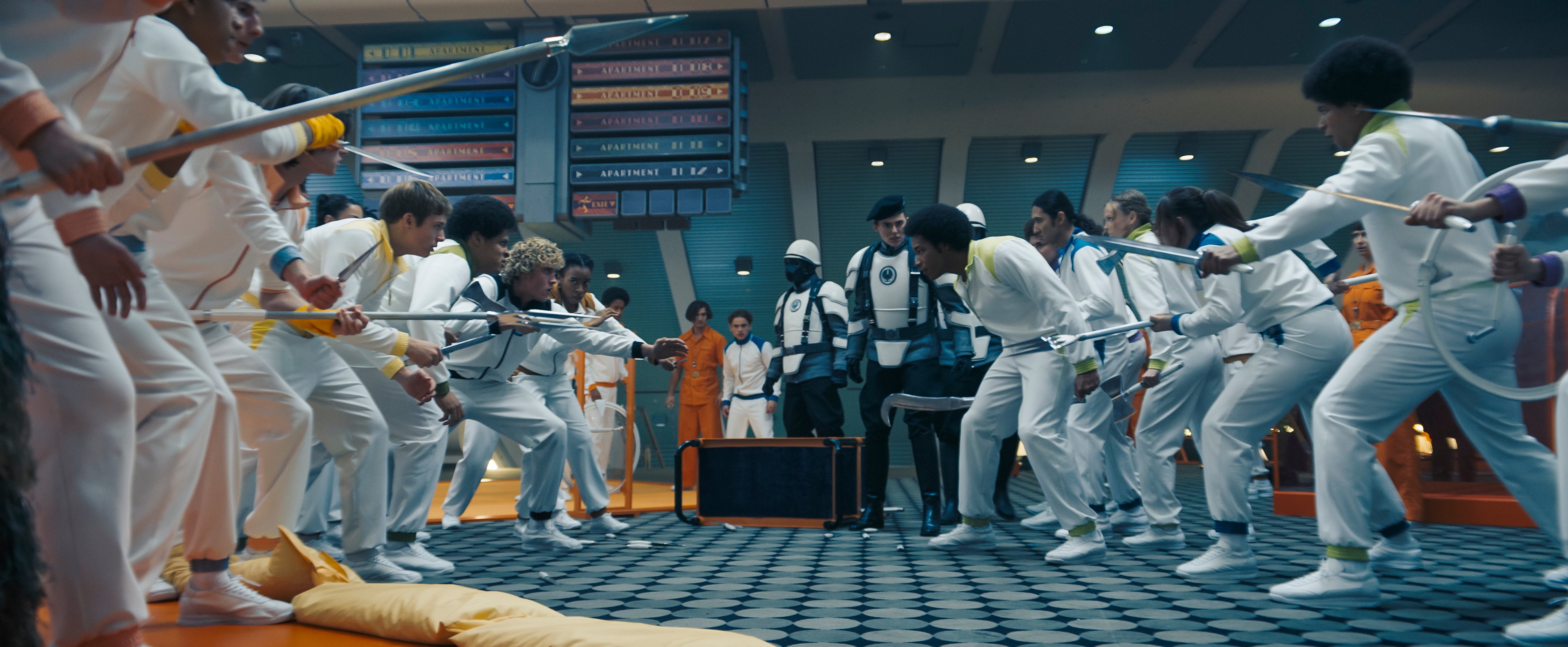

The different district tributes in "The Hunger Games: Sunrise on the Reaping."
Lionsgate
“It's such a difficult moment for him. He’s lost so many friends, and he had such a hard time and then he has to be dressed up in this glamorous suit and then he gets kicked out and goes back to his district,” Daigeler says. When he disembarks the train at the other end, he’s still wearing the suit which is now considerably less pristine as Daigeler imagined, as the Capitol didn’t give him a change of clothes. As she says, while “he wants to get rid of everything that has to do with the Capitol,” he physically can’t shed their mark on him.
While District 12's collective muted color scheme reflects its mining heritage and relative poverty, the other districts have their own visual identities and signature colors. Working with Pantone to establish these shades, the production landed on colors that felt reflective of each district’s identity. For instance, for District 3 and its characters—namely Beetee (Kelvin Harrison Jr.) and Ampert (Percy Daggs IV)—an electric blue tone was chosen to represent the district's association with technological developments. Aside from differentiating the tributes in their arena ponchos, which are striped with each district’s corresponding color, Daigeler also brought the shade into the characters’ wardrobes when we see them earlier in the film. “For Ampert, I went for this very simple, bright blue jumpsuit for the carriage scene,” she says. “That blue just transmits what the district stands for.”
For President Snow, Daigeler departed from the film’s broader 1960s and 1970s influences, opting for older references when it came to the cut and appearance of his tailoring. She felt he “wouldn't look powerful enough in ’70s suiting,” so she instead went more in the direction of the 1930s and ’40s. “So he gets that posture that comes with those strong shoulders of that kind of tailoring,” she explains. To help ground his sense of power, his suits were tailored specifically to Fiennes' measurements and used premium fabrics through the English costume house Cosprop. Daigeler also hand-embroidered roses on his lapels, a detail that ties the character to the earlier and later versions of him seen in the other movies in the franchise.
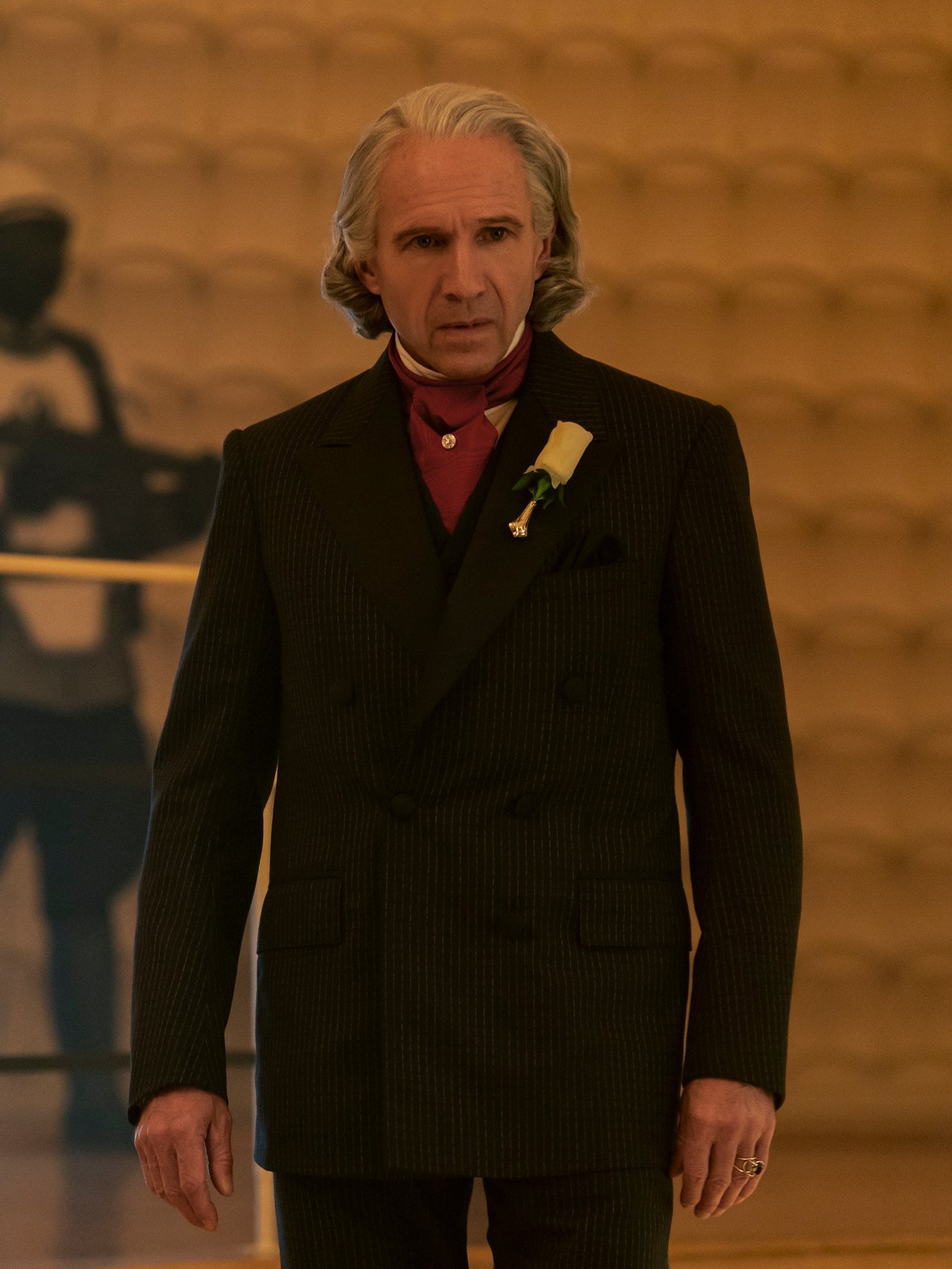

Ralph Fiennes in "The Hunger Games: Sunrise on the Reaping."
Lionsgate
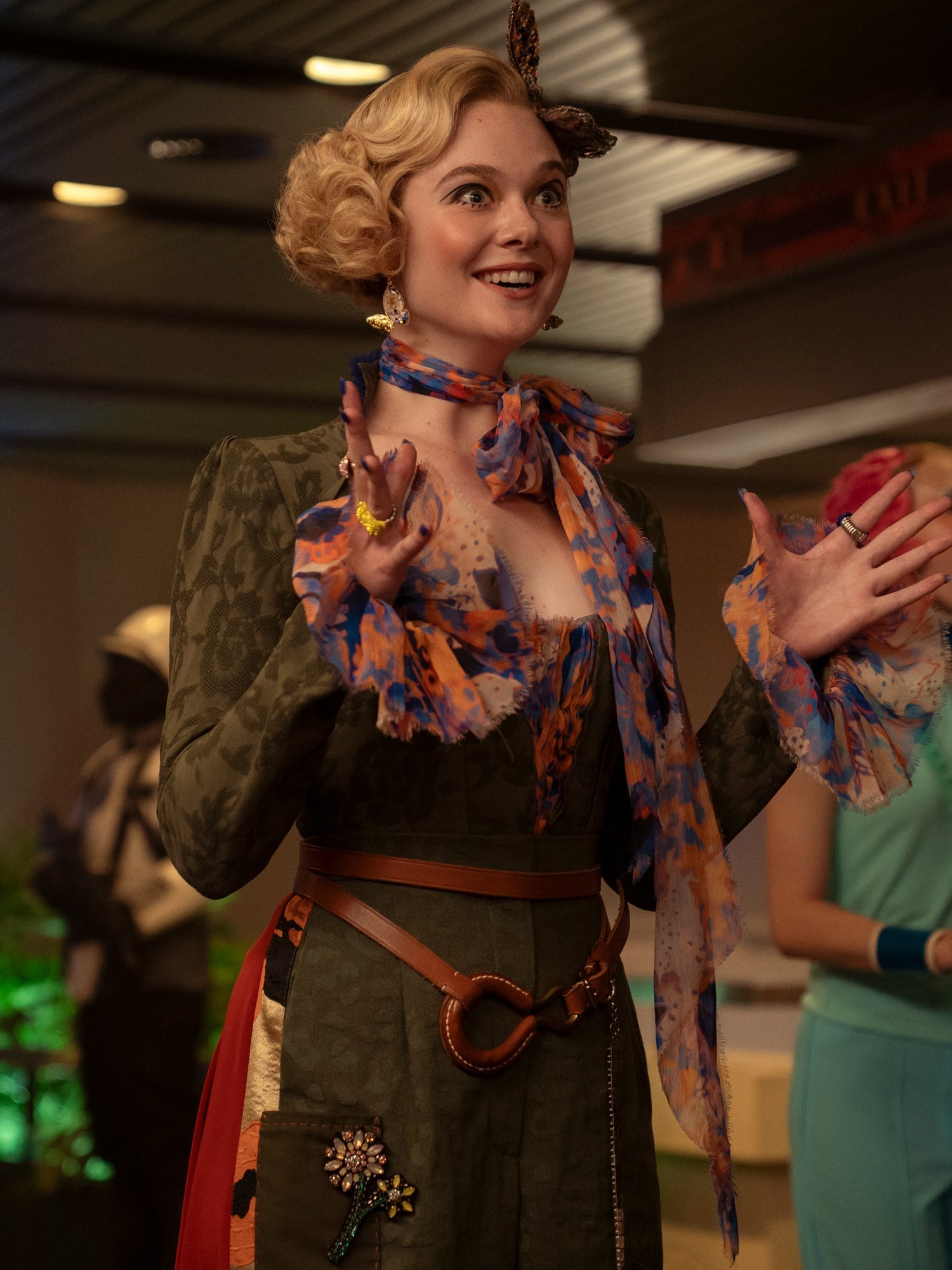

Elle Fanning in "The Hunger Games: Sunrise on the Reaping."
Lionsgate
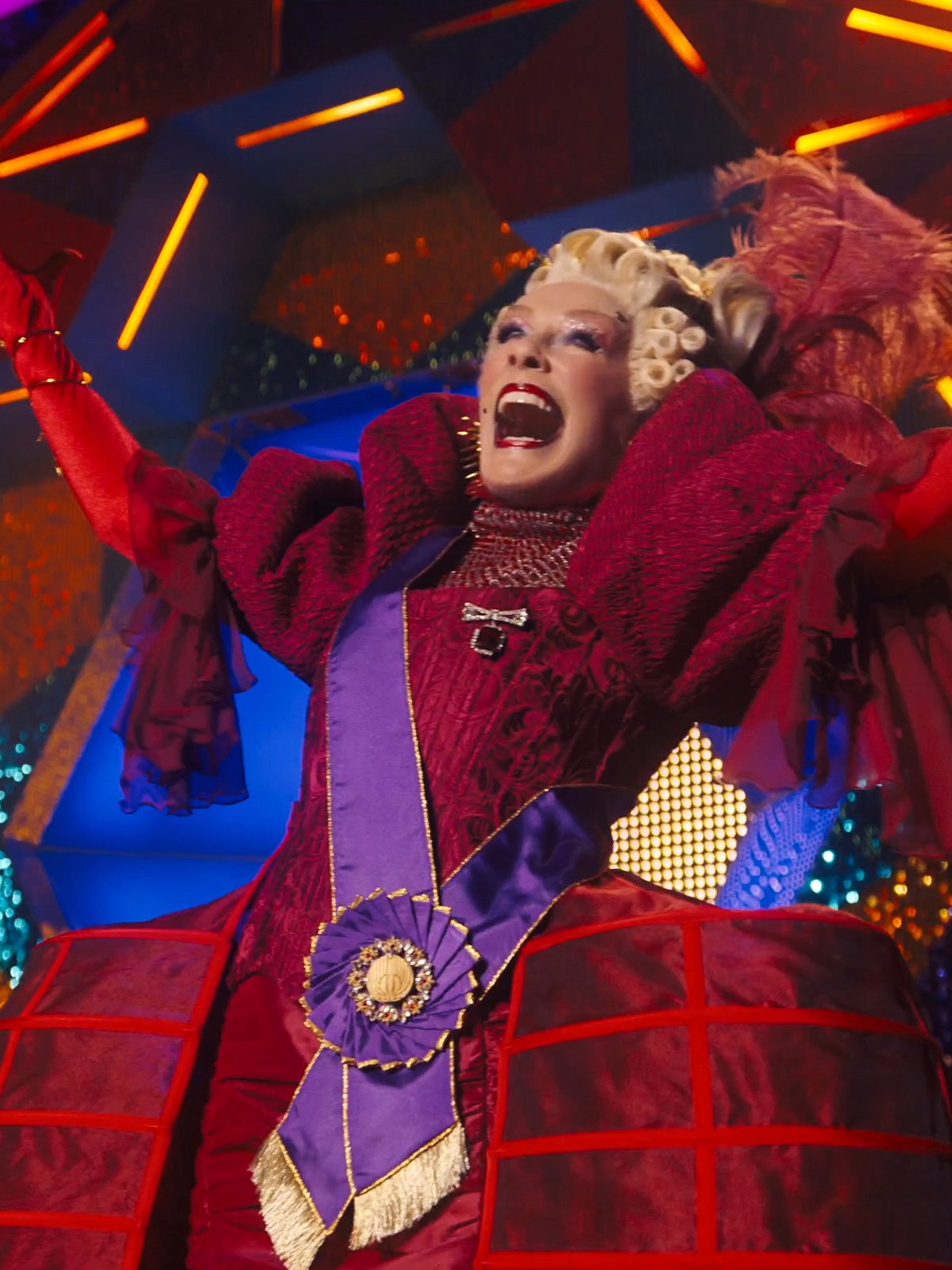

Glenn Close in "The Hunger Games: Sunrise on the Reaping."
Lionsgate
Ralph Fiennes in "The Hunger Games: Sunrise on the Reaping."
Lionsgate
Elle Fanning in "The Hunger Games: Sunrise on the Reaping."
Lionsgate
Glenn Close in "The Hunger Games: Sunrise on the Reaping."
Lionsgate
A similarly considered approach was taken with Drusilla Sickle (Glenn Close), the Capitol's flamboyant escort for District 12. Daigeler used recurring accessories, particularly military-inspired medals, to reinforce Drusilla's inflated sense of importance. Fashion influenced Drusilla’s grand entrance on the Reaping day too, with the idea being that she is wheeled in on a slant board not because she is so tightly corseted in that particular costume that walking is not an option.
For Effie Trinket (Elle Fanning), Daigeler wanted her wardrobe to convey the sense that she is someone who is still experimenting with her look. “The Effie that we know from the other movies is already very established, mature, and rich. And here I wanted to show an Effie Trinket that just has fun getting dressed and dressing people.” She drew on the distinctive look of designer Vivienne Westwood for many of Effie’s looks, but also made sure to incorporate butterfly motifs reminiscent of those worn by Elizabeth Banks in the original four films.
In general, Daigeler says that the Capitol's aesthetic needed to feel almost unsettling in its excess. “They express themselves in a very aggressive way through their image,” she says. “They need a lot of attention. You see that also in the extras. It's always very extreme and over the top.” She and her team found plenty of opportunities to embrace their wildest interpretations of Capitol dressing for the tribute chariot sequence alone, which required dressing 1,500 extras, each with their own colorful and loud look. “It was a huge task but was really stunning to be part of it and to see how creative my team got when putting the looks together,” Daigeler says. “It was a highlight of the movie for me.”