In 'Imperfect Women,' Perfect Homes Hold Secrets
Interiors


Interiors
From a downtown LA loft, a Pasadena mansion, and a cozy SoCal bungalow, production designer Jon Carlos uses design to expose the fault lines of friendship in "Imperfect Women."
In “Imperfect Women,” Apple TV's limited series adapted from Araminta Hall’s novel of the same name, non-profit CEO Eleanor (Kerry Washington), society wife Nancy (Kate Mara), and stay-at-home mom of three Mary (Elisabeth Moss) are college best friends. “We were supposed to grow old together,” Eleanor says as she recounts their shared history to detectives after Nancy is found murdered.
As Eleanor and Mary mourn their best friend and band together to find answers, they uncover bombshell secrets and devastating fractures in their longtime friendship. Along the way, their distinctive homes also reveal their individual personalities and ambitions, the parts of themselves they’d rather keep hidden, and their deep bonds with one another.
“The design team and my partner, set decorator Ellen Reede, needed to create three very distinct spaces that say so much and define each character,” says three-time Emmy–nominated production designer Jon Carlos. “But the three women are so interwoven that they also have to be able to walk effortlessly into each other’s spaces and feel as if they could exist there very naturally.” Ahead, Carlos breaks down the character and plot clues hidden within each dwelling.
Eleanor’s Downtown Art Deco Loft
Eleanor drives her vintage Mercedes-Benz 450SL back from Mary’s house to her apartment amid the bright lights of fast-changing Downtown Los Angeles. She turns the key to enter her nondescript front door—no doorman—and walks through the dark, dimly lit hallways to find Nancy’s husband, Robert (Joel Kinnaman), waiting for her. “We created the walk-up to her space to have a bit of a misdirect,” says Carlos. “You still feel the natural grittiness of the exterior environs, and then we enter a space completely revitalized.”
That’s because Eleanor comes from generational wealth— it funds her non-profit as well as her renovated luxury Art Deco loft, which was actually built on a sound stage. (Her ground floor and lobby are an existing building.) Carlos explains that during the 1930s, downtown’s Broadway corridor was a glamorous Old Hollywood hot spot, a legacy the city has been trying to revive. “Eleanor, to me, is the type of person who is always trying to rehabilitate,” says Carlos, pointing to her international relief efforts. “It made perfect sense that where she would live is also a rehabilitated space.”
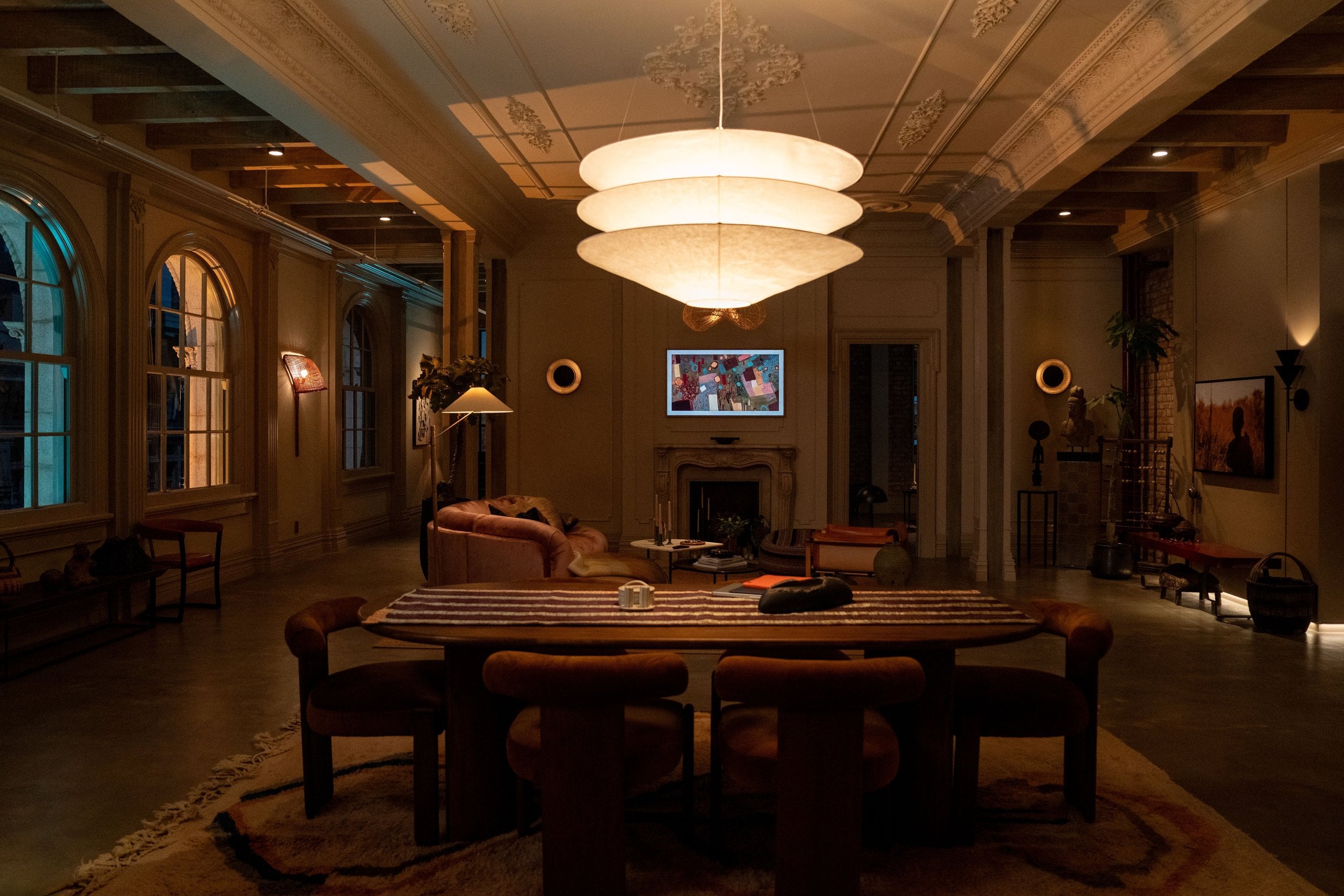

The interior of Eleanor’s Downtown loft was built on a soundstage.
Apple TV


“Each corner was basically an art gallery for her. You could tell kids don’t live there."
Apple TV
The interior of Eleanor’s Downtown loft was built on a soundstage.
Apple TV
“Each corner was basically an art gallery for her. You could tell kids don’t live there."
Apple TV
After scouting historic Art Deco lofts on Broadway, Carlos drew inspiration from a space that once served as a majestic ’30s-era boardroom, complete with a “floating ornate ceiling,” and imagined how Eleanor would have made it her own. “All the columns throughout her apartment are the existing perimeter of what would have been the paneled boardroom—and she basically ripped all the walls out,” he says. “She's always preserving the past, but then she's putting her glossiness on top.”
Her chic and curated interior decor is a mix of vintage and high-end contemporary furniture. Artwork and artifacts from her aid work travels adorn the expansive space throughout the rooms. “The versatility of international travel shows her sophistication, her strength, and her ability to take an object—something as simple as a cooking pot—bring it in, place it on a pedestal, and elevate it,” says Carlos.
The profuse amount of delicate artwork and angular sculptures also signifies Eleanor’s independent lifestyle. “Each corner was basically an art gallery for her,” says Carlos. “You could tell kids don’t live there: hard-edged marble pillars, windows without railings. She was the one without children, so she could live a little more dangerously—or freely, I should say.”
Mary’s Real, Lived-In Bungalow
Mary, a promising writer and creative storyteller, put her dreams on hold to marry Howard (Corey Stoll), her former professor and now-floundering academic, and raise their three children. Her life is focused on her family, which comes through in her cozy bungalow. Unlike Eleanor’s soundstage-built loft, Mary’s lovingly cluttered kitchen and back porch exist in a real home—essential for welcoming viewers into the trio’s friendship, which endures despite their divergent paths after college.
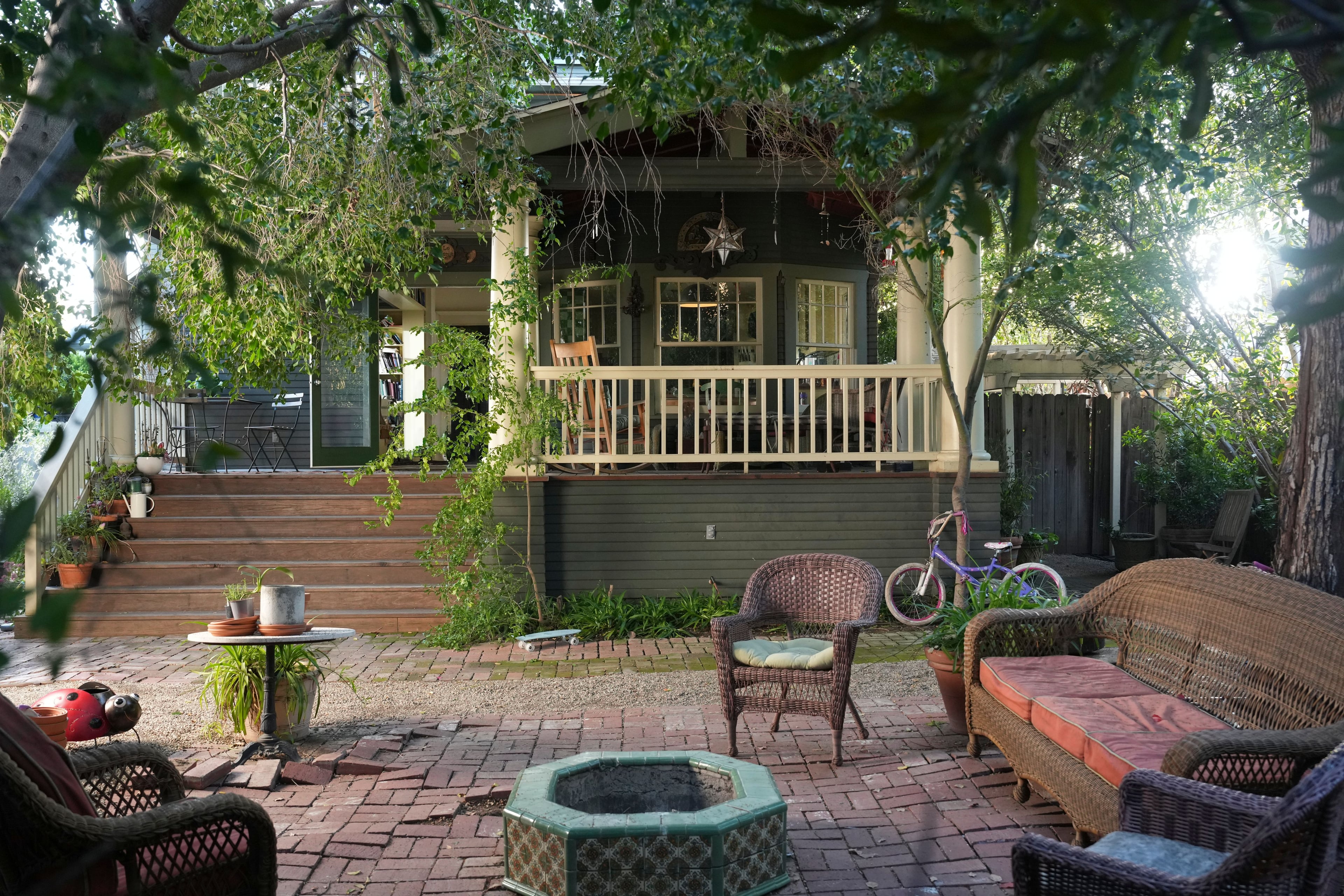

"Mary’s house felt less aspirational and more truthful, which was essential for connecting with this trio," says production designer Jon Carlos.
Apple TV
“All of us agreed very early on that a real house—with real plaster, real cracks, authentic lighting, and genuine views—was crucial,” says Carlos. “It captured the texture of the power lines, the palm trees, the sensibility of the neighborhood, and everything that is LA to an Angeleno. Mary’s house felt less aspirational and more truthful, which was essential for connecting with this trio.”
The actual home also offered a backstory that bolstered the one unfolding on-screen. Carlos points to the eye-catching turquoise and dark-green checked tile pattern in the kitchen where much of the drama unfolds. “The homeowner actually ordered it from an artist in Mexico and drove down three times himself to pick it up, bring it back, and then hand-laid it in himself,” says Carlos. “We thought that's something that Mary would have done.” The two-tone greens in Mary’s kitchen also coordinate with the dark, moody walls of Eleanor’s hallway and her wardrobe color palette. Nancy’s high-end designer pastel ensembles also effortlessly harmonize with Mary’s home. “The softness of the kids' art, the flowers, and the decorations, brought a little bit of Nancy into Mary's space,” says Carlos.
Nancy’s New Life, Old-Money Mansion
At first glance, Nancy lives a gilded existence: married into a legacy finance dynasty, serving on the boards of prestigious cultural organizations, and ensconced in a palatial mansion in Pasadena. “We looked at over 50 different estates,” says Carlos, describing the challenge of finding a single location that could host familial disputes in sunlit rooms, steamy revelations in moody lighting, and opulent poolside parties.
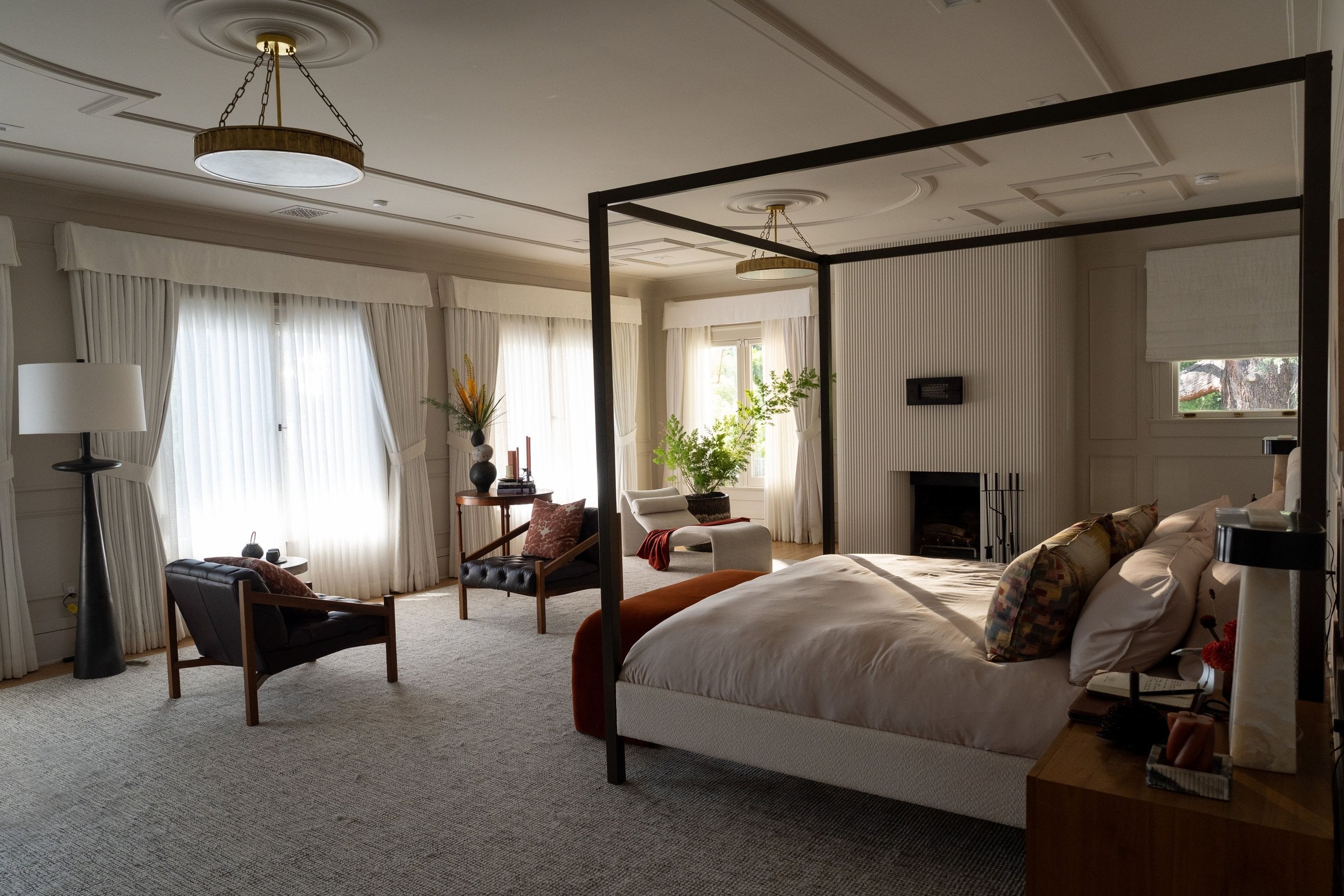
For Nancy’s manse, passed down through Robert’s lineage, the team landed on a sumptuous manor in Hancock Park. “The house itself was completely white—trim, walls, everything on the outside—same thing with the inside,” says Carlos. “I wanted to set a baseline that was absolutely the Hennessy family. The old East Coast money and staunchness that the family would have in terms of the morals and their values that has to be apparent in the walls."
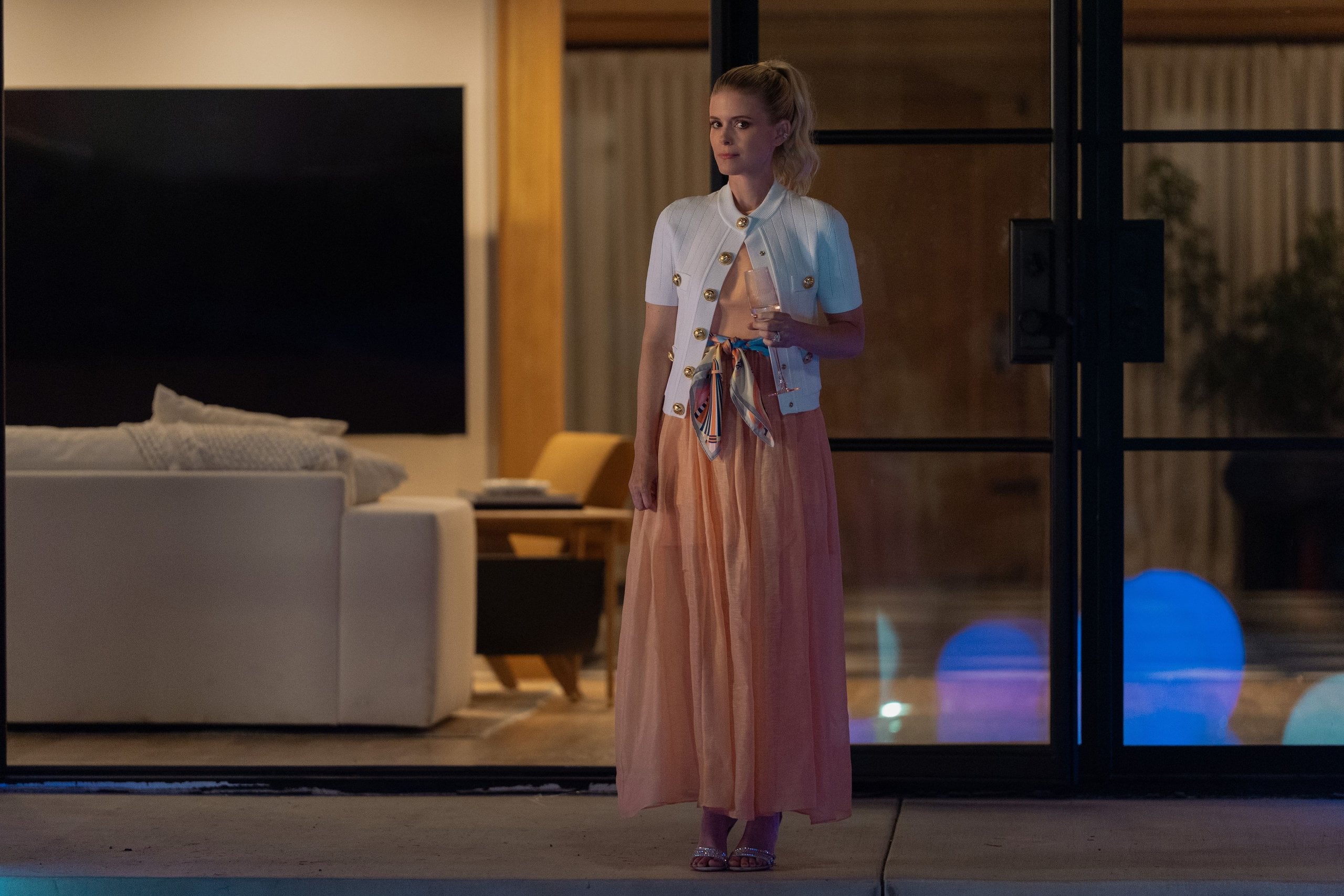

At first glance, Nancy lives a gilded existence in her palatial mansion in Pasadena.
Apple TV

The home is immaculately decorated—fitting Nancy's lifestyle perfectly.
Apple TV
Carlos imagined that Nancy pushed back against the Hennessys’ “suffocating” rules by renovating stuffy, “dark mahogany”-filled rooms—probably in close collaboration with an interior decorator to the 1 percent. Contemporary high-end designers showcased in Nancy’s house include Ramone Munoz, Zver, Kibby, Provart, and Longo. “So Nancy came in and basically pushed back on the family impositions,” says Carlos. “She stripped all the wood to go to these natural, sealed honey tones. She came in with interior design and wallpaper aesthetics that were sharper, more fierce, playful, and dangerous on the lower level.”
Carlos added wood paneling and molding to the spaces, nodding toward the pervasive Hennessy influence over Nancy, who made sure her bedroom was completely hers, though. “It’s softer, lighter. Her bedroom is white,” says Carlos. “The bedding and art have a bit more softness, but still some of the fracturing that you see downstairs. Like, the art has strong, black, drippy lines, but it's delicate and simple and less aggressive. It’s playing off the scars that Nancy would have had from her very dark past.” Even in Robert’s man-cave library, Nancy’s touch is palpable.
“She absolutely would have designed it,” says Carlos, pointing to the dark navy and gold painted bookshelves and taupe and blue ceilings. “She brought this darkness into that space, but it was still sophisticated and elegant and very pleasant on the eyes. That's what Nancy was. She's harboring so much darkness on the inside, but there's still a presentation of brevity.”
Eleanor looms quietly large in Robert and Nancy’s life—and in the décor, with seeds and plants she brought back from her travels in Africa and South America. She nurtured them in her loft and corner office and shared them with her best friends. “There were some trees in Nancy’s garden room that were the same as those Eleanor would have,” says Carlos, subliminally connecting the friends. “We played with the idea of what gifts they might have given each other in each other’s spaces.”