
How ‘I Love Boosters’ Built Its Bold, Hyper-Saturated Fashion Universe
Fashion
TSS Creative
Shirley Kurata
Costume designer Shirley Kurata breaks down the creativity, color, and fashion rebellion in visionary writer-director Boots Riley's "I Love Boosters."
During a heist montage in Boots Riley’s “I Love Boosters”—a wild ride of social commentary, sharp satire, absurdism, trippy sci-fi, and electrifying fashion—fans of pop culture juggernaut “Everything Everywhere All At Once” might experience a flash of déja vu. That’s because Oscar-nominated costume designer Shirley Kurata is behind both films’ fantastical explosion of high-impact monochrome, bolts of neon, conceptual silhouettes, and experimental textures. “For years I've been collecting just looks—via Pinterest, Instagram, runway looks, people on the street—that are super fun and cool,” says Kurata, who’s also a veteran Los Angeles stylist (and Rodarte’s campaign go-to). “All the looks that I hoped to use one day worked for the movie.”
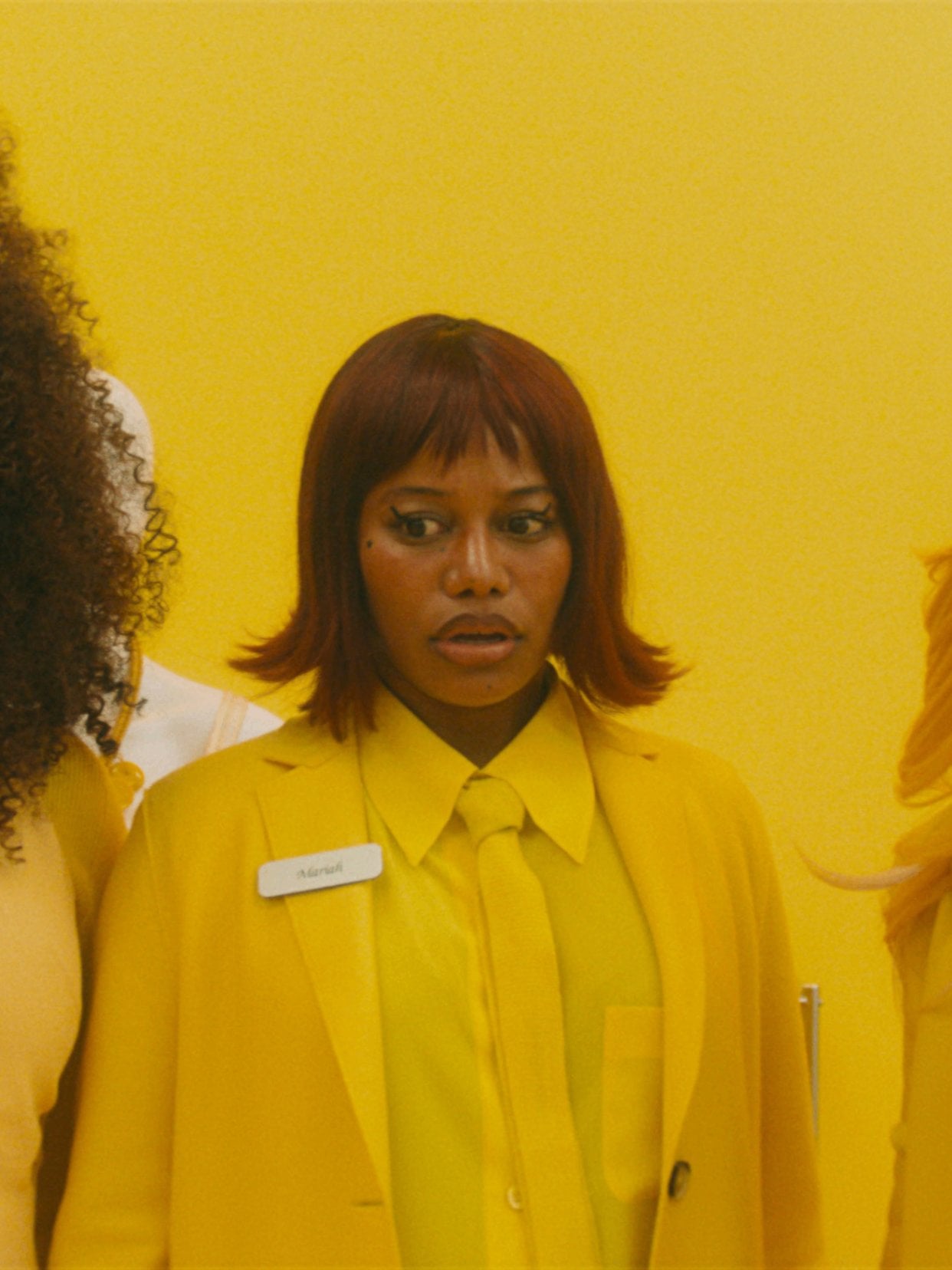
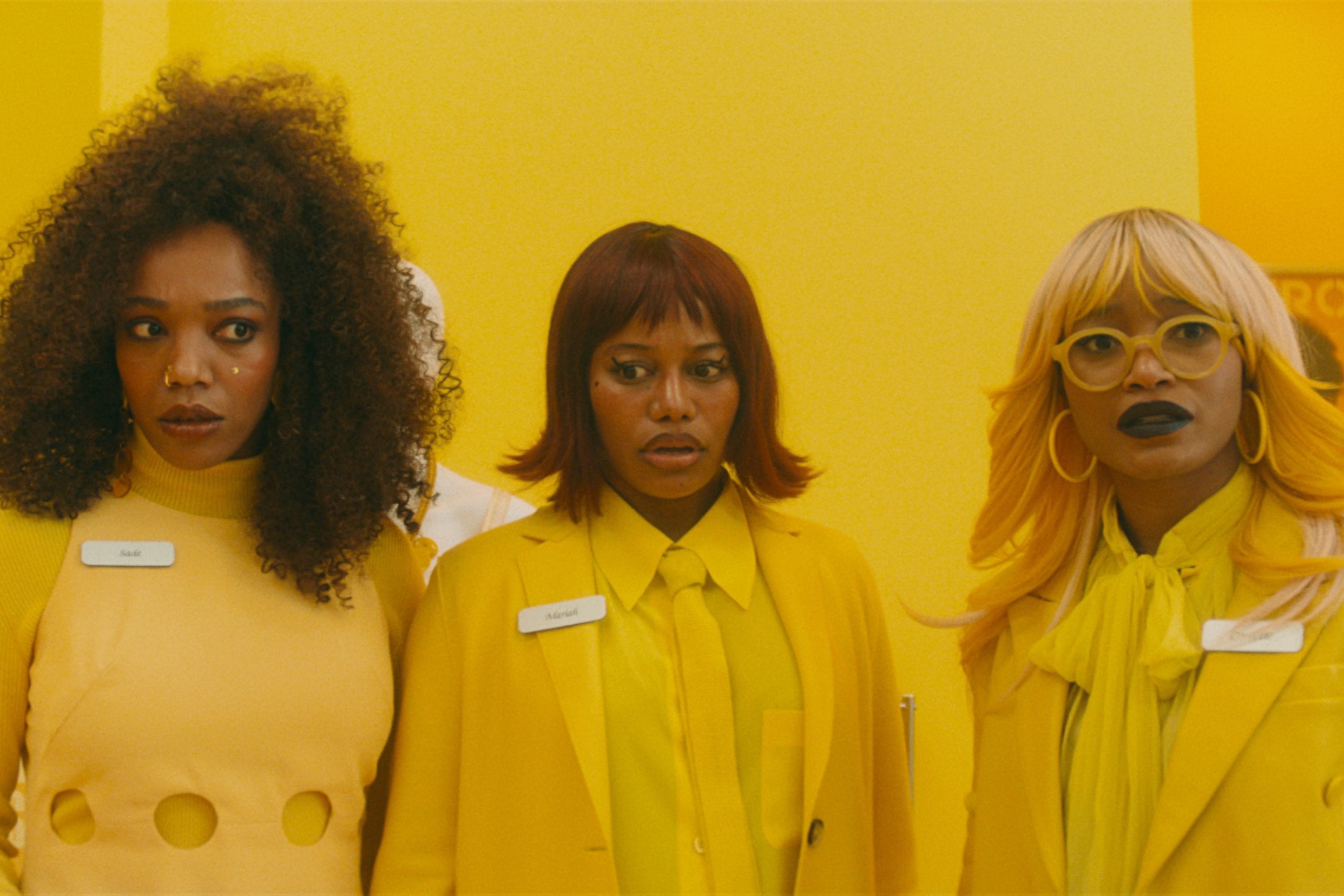
The film follows the Velvet Gang, a Robin Hood-esque trio, headed by aspiring fashion designer, Corvette (Keke Palmer). Alongside her ride-or-dies, Sade (Naomi Ackie) and Mariah (Taylour Paige), Corvette steals—or “boosts”—overpriced clothes and accessories to resell at affordable prices within their community. “Triple F: Fashion. Forward. Philanthropy,” says community-minded Mariah, emphasizing the “branding” over nitpicking the spelling.
The Velvet Gang’s main target is the monochromatic Metro Designers, the empire of Christie Smith (Demi Moore). The fashion overlord co-opts style from urban neighborhoods and repackages it for the economically privileged at inaccessible prices, all while exploiting her workers. With Mariah as the getaway driver for an early job, Corvette and Sade skillfully cram as many highlighter-green Metro Designers pieces as they can into the copious storage spots in their clothing. Their eye-candy outfits are based on the functional uniforms of real-life boosters. “Boots gave me a lowdown,” says Kurata. “They just stuff it in their clothes and have special pockets lined with foil to not trigger the sensors. Other people would wear a long skirt with a basket between their legs.”
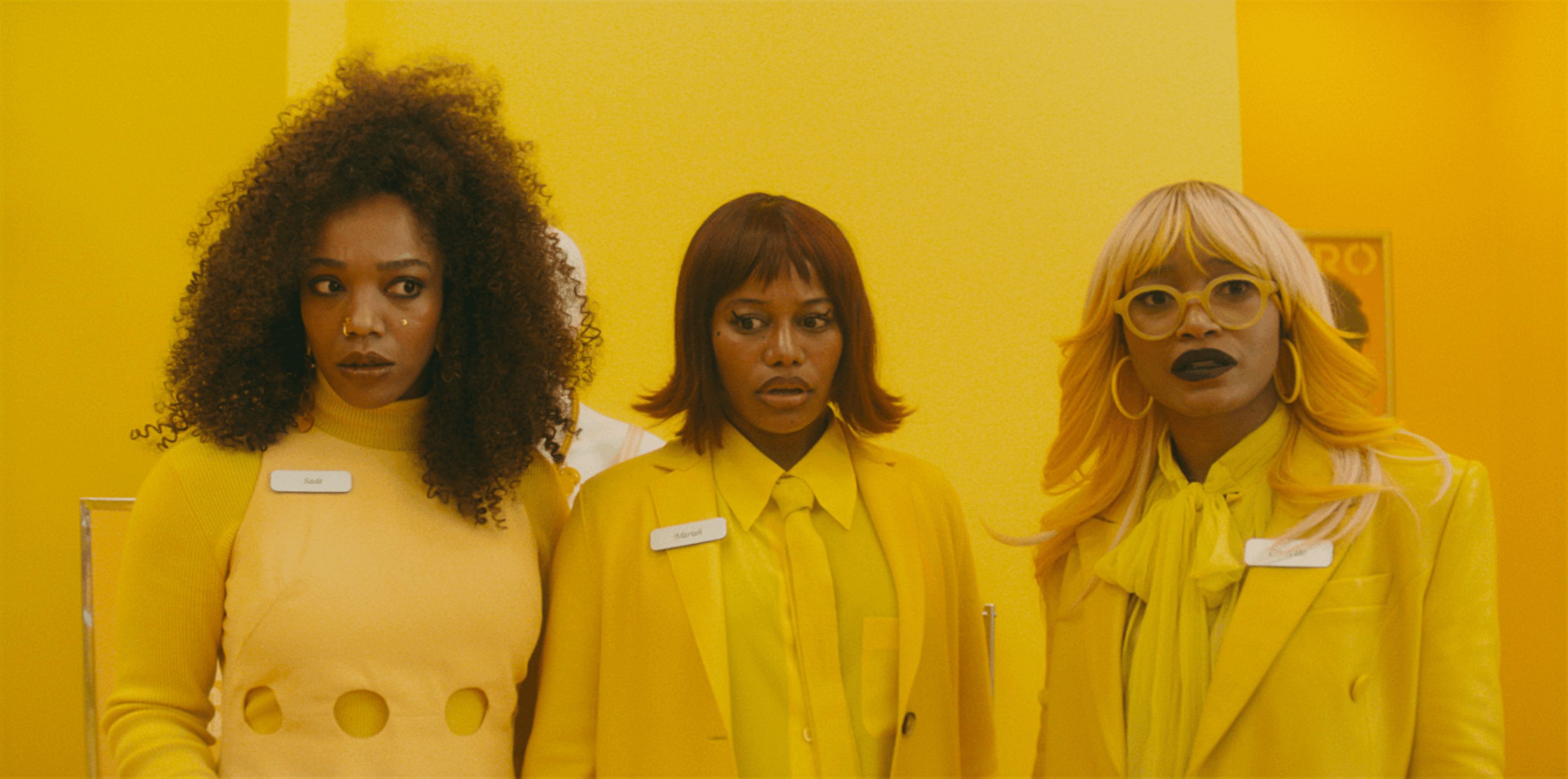
Naomi Ackie, Taylour Paige, and Keke Palmer in "I Love Boosters".
Neon
For Ackie’s character Sade, Kurata found a roomy wrap-skirt made from old windbreakers by Suay, a Los Angeles-based vintage upcycling and socially conscious label. “The skirt had an opening so that she could just stuff the clothes in the basket that was tied to her thighs and hanging,” says Kurata, pairing the skirt with a voluminous orange jacket from AAPI-owned LA-based KkCo. “It had pockets, so it was a good piece to hide things.”
Kurata made a point to work with up-and-coming brands, BIPOC designers like Sergio Hudson, Anna Sui, and Leeann Huang, as well as SCAD fashion students for the movie’s finale runway show. (“I went into a class and the designs were in development, in toile or muslin,” she says. “I was like, ‘Can you just do it in all red or blue?’”)
Kurata also engineered Corvette’s spacious pink Juicy Couture-like tracksuit, which billows into a Stay Puft Marshmallow Man shape for some excellent physical comedy. “Early on, I got a tracksuit in a bigger size and just experimented by putting in pillows and blankets and took pictures to send to Boots,” says Kurata, with a laugh. “We actually did have to pad it up and stick in some clothes and hangers.”
The Velvet Gang teams up with Jianhu (Poppy Liu), an exploited factory worker from China, for an ambitious round of Metro Designers heists—offering a fast-cut montage of eccentric, surreal, and humorous disguises. As she did for Stephanie Hsu’s elaborately outfitted, nihilistic antagonist in “EEAAO,” Jobu Tupaki, Kurata looked to Japanese streetwear magazine, “Fruits.” “I love that book,” she says, about the inspiration for the playfully stylized, kaleidoscopic raver motif. Additional themes include period pieces, from Mariah’s ’50s to Corvette’s ’80s glitz, and a gardenful of lush, blooming florals.
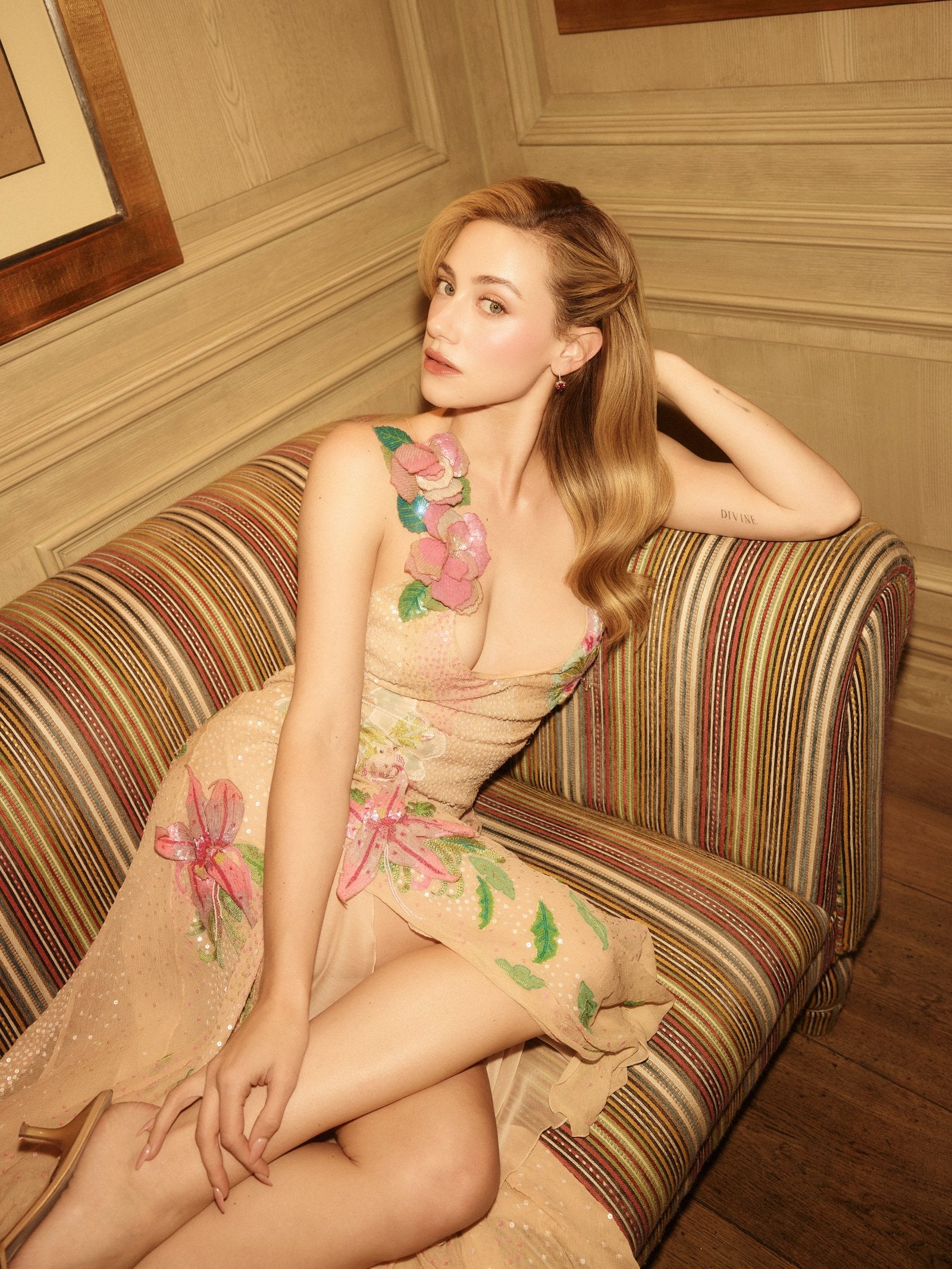
“For Corvette, I was able to rent a Moschino Spring 2018 runway look— a flower cape dress,” says Kurata. “Then I was gluing on more flowers and making it even more floral.” But Corvette actually reveres Christie Smith—as also evidenced in the dreamer’s inventive, self-made wardrobe. “In the opening scene, she’s wearing a skirt that is made out of ties and her top is a [sports] jersey that she tweaked to be a little bit more fashion forward,” says Kurata, also pointing to an athletic-striped T-shirt worn under a red basque-waist jumpsuit for a pyramid-scheme meeting that Sade takes her to. “She’s wearing a top that’s just made out of tube socks,” Kurata continues. “I just want to have little accessories or details that show her creative side. Her wardrobe obviously had to involve color, too.”
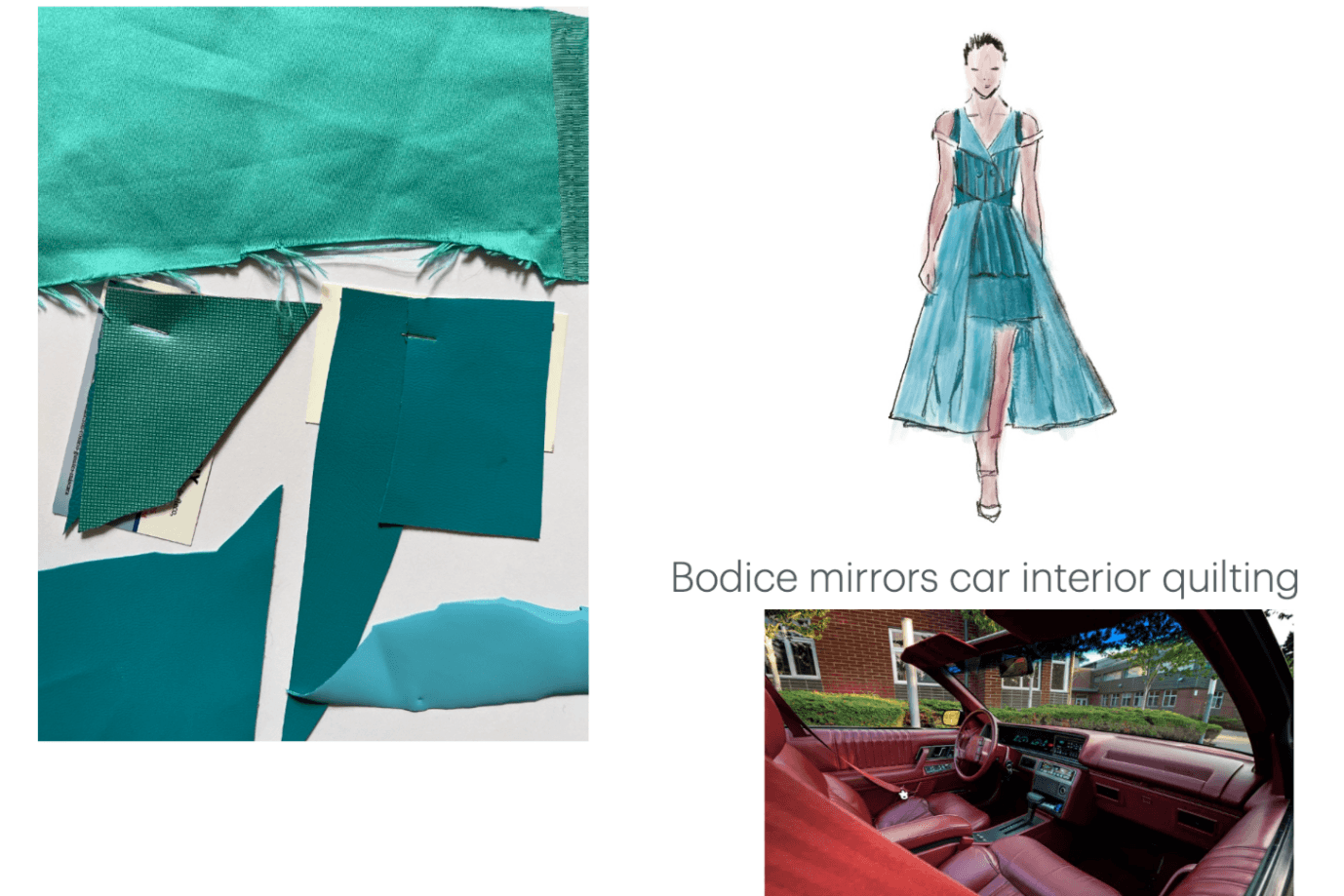

Corvette's turquoise dress
Shirley Kurata
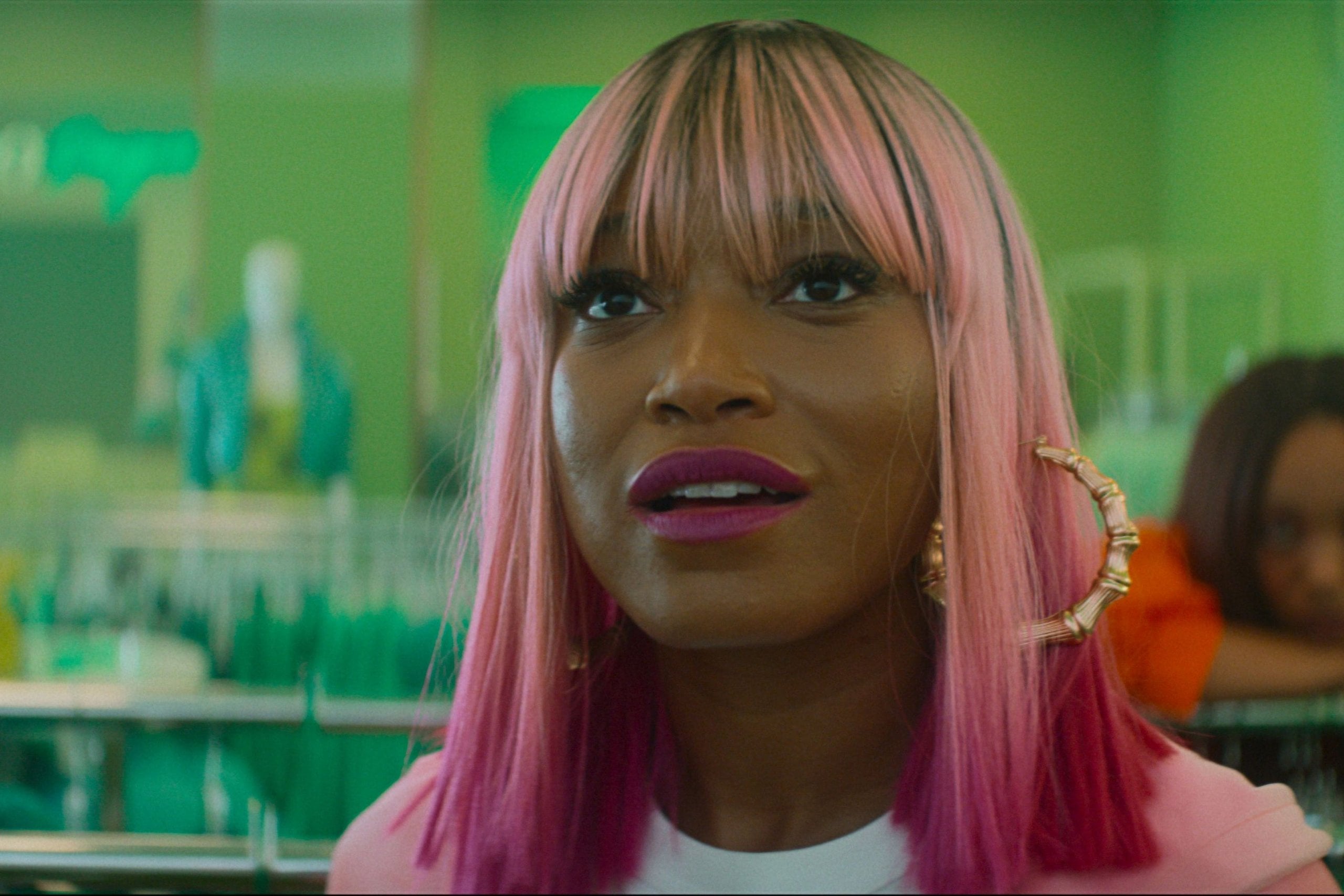

Keke Palmer in "I Love Boosters".
Neon
Corvette's turquoise dress
Shirley Kurata
Keke Palmer in "I Love Boosters".
Neon
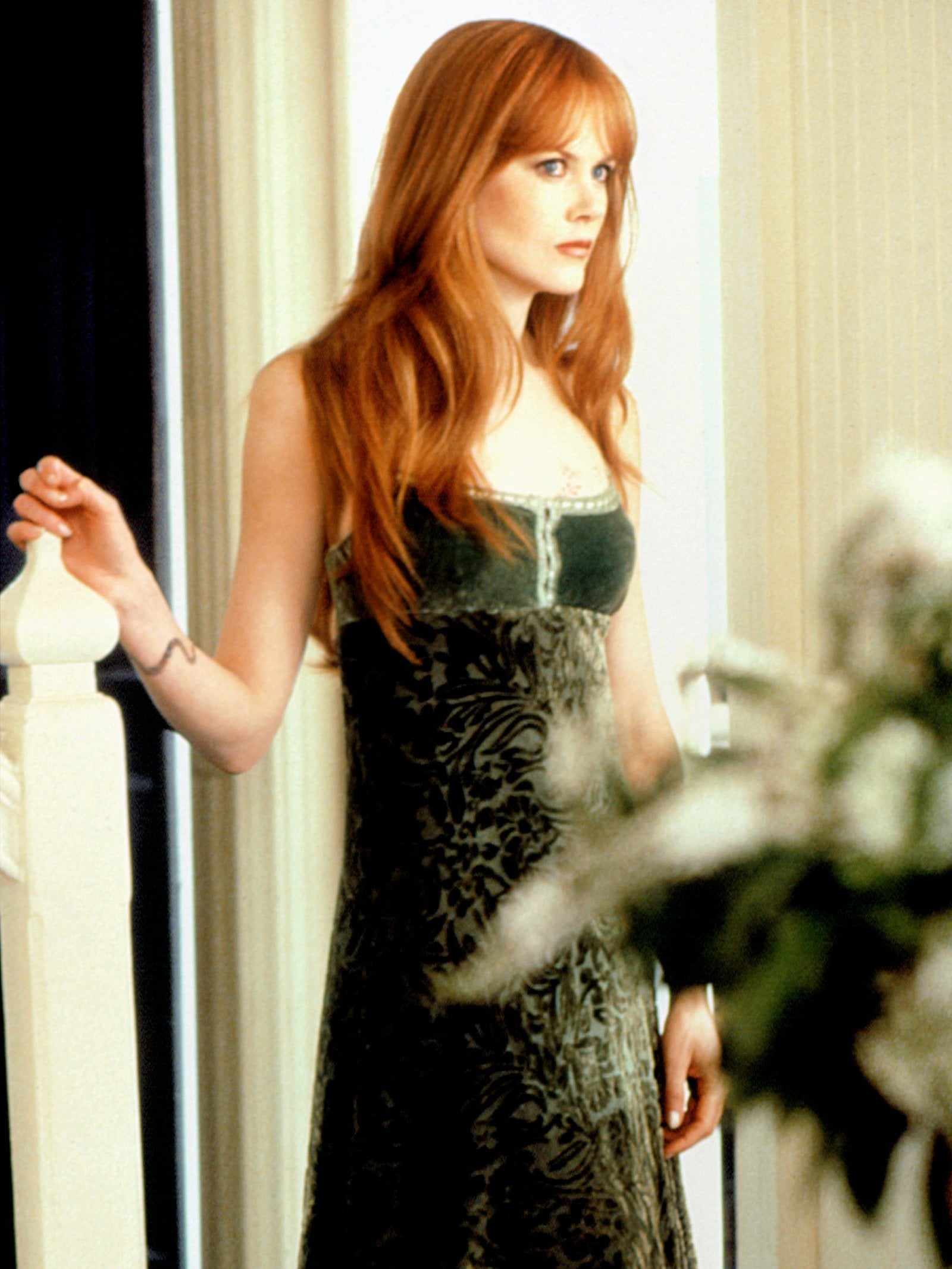
Within a movie full of striking monochromes, conceived with production designer Christopher Glass, Corvette’s signature is her beloved blue. “Turquoise makes me believe in hope for the future,” she says to Christie after sneaking into her idol’s luxury San Francisco abode—hilariously tilted, both as a nod to the city’s sinking Millennium Tower and as a reflection of the socio-economic imbalance the fashion mogul benefits from. Christie, at first, compliments Corvette on her sculptural custom-made trench-dress, with a distinctive obi-belt.
“The color was her comfort blanket. It reminded her of her youth,” says Kurata, taking inspiration from Corvette’s childhood memory of riding in the back of her parents’ turquoise-hued car. “I wanted to have details that mimicked the car interior, using car upholstery fabric and chrome detailing. The panels of her skirt have quilting like that you would see in an ’80s Oldsmobile.”
Christie—in stark, all-black Thom Browne, with a sharp-edged asymmetrical fan detail on the bodice—stands atop her sloped floor and condescends to Corvette. “It’s not turquoise,” she snaps, correcting her admirer. “It’s aquamarine.” “Sometimes people in the fashion world are judgmental in how other people are dressed and so not wearing color felt a little more of that, like ’I'm an artist and I know what dictates fashion,’” says Kurata.
Christie commands in a severe palette of black, white, and touches of gray, including a shorts suit with raised, razor-edged geometric shapes by Victoria Yujin Kwon, whom Kurata discovered through Instagram. The severe asymmetry in Christie’s wardrobe represents her discerning taste, as well as her skewed apartment and elitist sense of superiority. “Christie was very into art,” says Kurata. “And the meaning of what she thought was art—and her entitlement to it.”
Moore’s own fashion taste also influenced Christie’s wardrobe. The Oscar-nominated actress brought her Selfridges haul, featuring a triple-sleeved Commes des Garçons blazer and more avant-garde pieces, to a fitting. Kurata then incorporated some of the pieces into Christie’s wardrobe. “I'm drawn to these things that are uniform-like, but still show a lot of thought and creativity,” she says. “So Christie wasn't basic.” Neither are the “I Love Boosters” creative minds, who mirrored the inventiveness and excitement of the film behind the scenes. “Brightness was cranked to eleven,” observed The New Yorker of the film’s exuberantly clad crew—including Riley and his trademark headwear from UK-based Uptown Yardie, which celebrates founder Rohan Clarke’s Jamaican heritage.
“We even had a ‘Dress like Boots’ day. So everyone from the crew tried to make their own version of his hats. That was probably the most fun we had,” says Kurata, thinking back to Glass’ hyper-saturated sets, too. “Maybe that gave us even more of a desire to match the sets and wear some bright colors.”