
For 'Paradise' Season 2, Costume Designer Coxy Raided Elvis’ Closet
Fashion
TSS Creative
Coxy .
From aging and dying baseball jackets to taking looks from the Presleys' lives at Graceland, costume designer Coxy breaks down the key looks of “Paradise” season two.
When “Paradise” returned to Hulu for its second season, audiences found themselves transported from the hyper-controlled luxury of the bunker into the unknown, post-apocalyptic world above ground. For costume designer Coxy, taking over from Sarah Evelyn, opens in new tab from season one, that shift brought both a fresh creative playground and a daunting logistical challenge. “Season one established the bunker’s language—wealthy, contained, Americana,” Coxy says. “Season two is about venturing outside. We hadn’t seen the real world yet, so we had to create a visual language for survival.”
Season two unfolds three years after ‘The Day,’ the cataclysmic event that wiped out all modern infrastructure and set civilization back 500 years. For Coxy, that meant grounding the costumes in resourcefulness rather than fantasy. “There’s no more electricity, no production, no new fabrics,” she says. “Everything people wear is what they found, traded, or mended.”
Among season two’s most memorable segments is the Graceland arc, where new character Annie (Shailene Woodley) is living in isolation, surrounded by the relics of Elvis Presley, having been on shift as a tour guide at the Tennessee tourist attraction on ‘The Day’. Coxy notes that it’s not necessarily a bad place to find yourself—if, like her, you’d relish the opportunity to raid an icon’s closet. For Annie, though, it all comes down to practicality as we see her strip the house’s mannequins of their thickest layers to stay warm. “That’s her bunker,” Coxy explains. “What she has available is Elvis’s closet, Priscilla’s closet, and all the merchandise from the gift shop.”
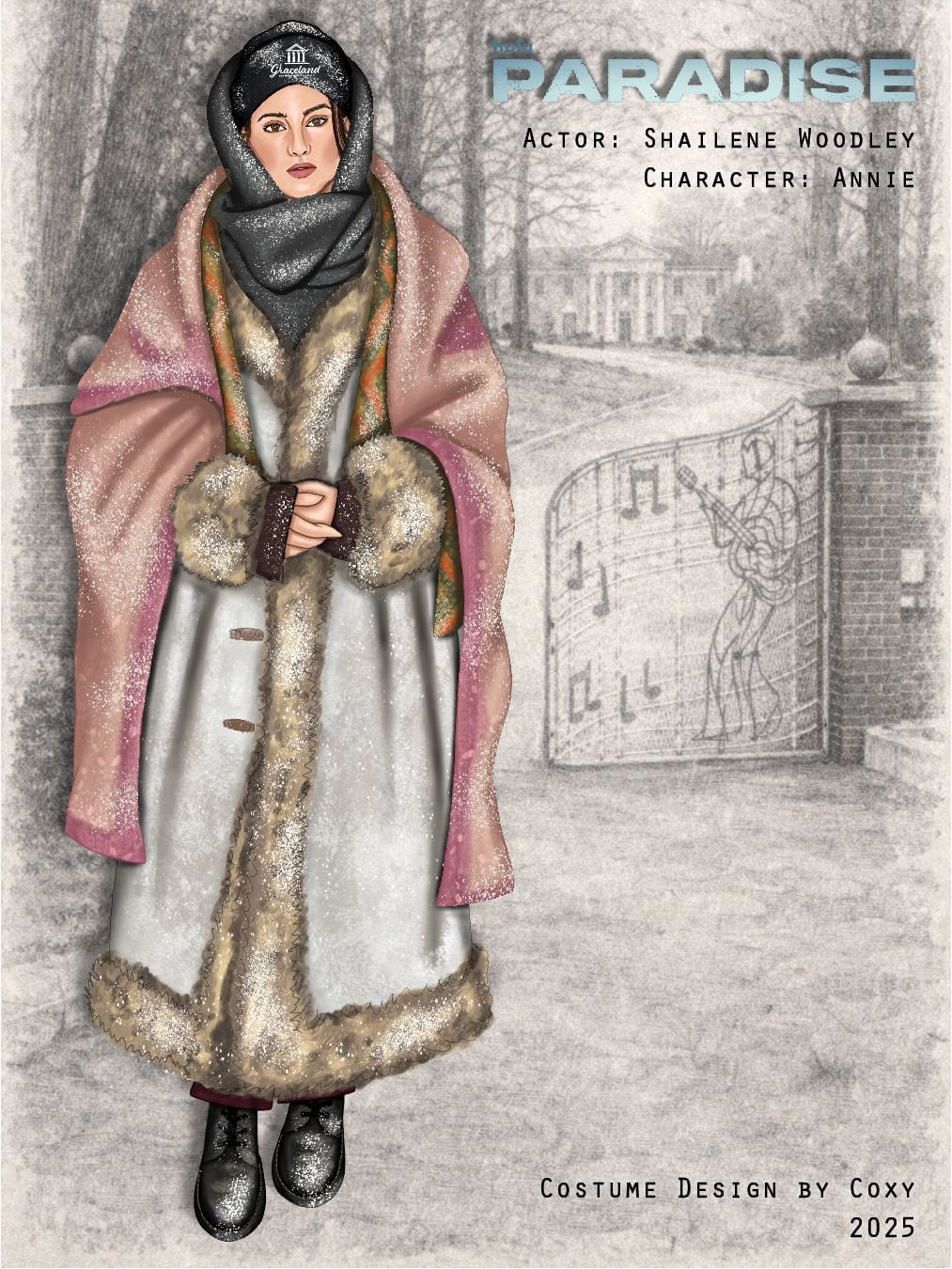

Coxy's sketch of Annie's (Shailene Woodley) costume for episode one of "Paradise" season two.
Coxy
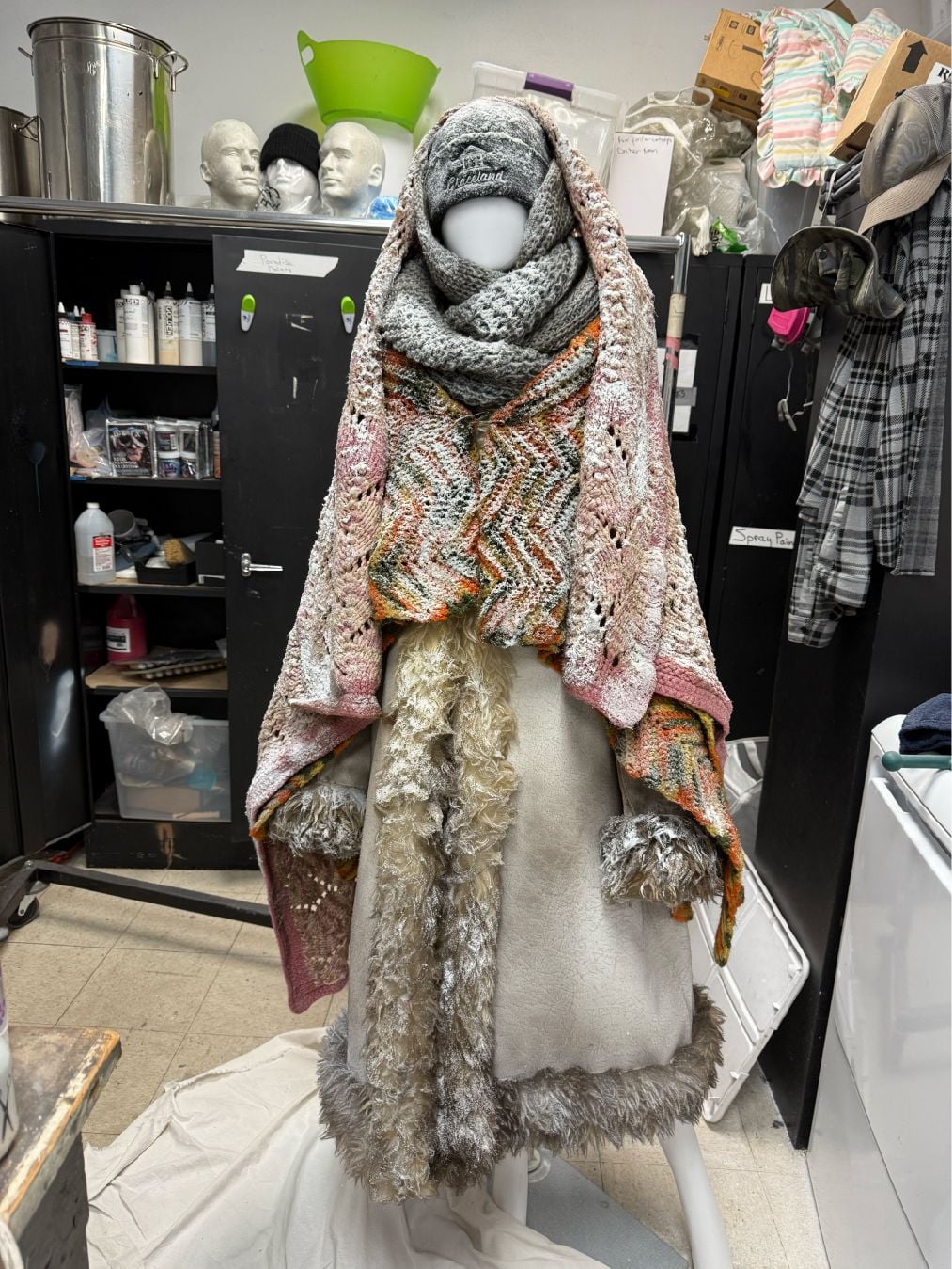

Annie's episode one costume on a mannequin.
Coxy
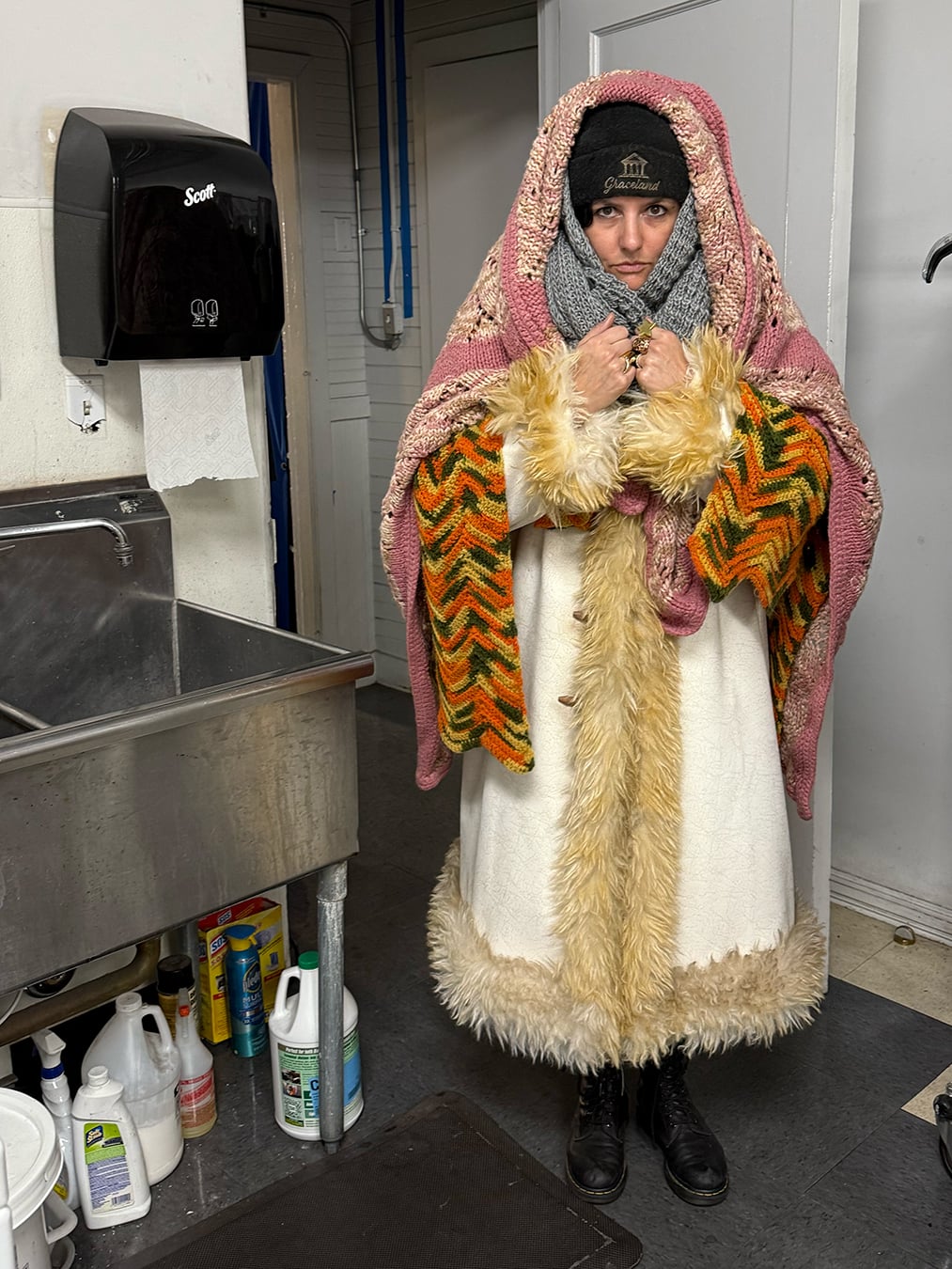

Coxy in Annie's (Shailene Woodley) costume for episode one of "Paradise" season two.
Hulu
Coxy's sketch of Annie's (Shailene Woodley) costume for episode one of "Paradise" season two.
Coxy
Annie's episode one costume on a mannequin.
Coxy
Coxy in Annie's (Shailene Woodley) costume for episode one of "Paradise" season two.
Hulu
When it came to putting together Annie’s survivalist wardrobe, Coxy took a trip to the real Graceland to poke around. She was amazed to find just how much clothing, jewelry, and accessories were on display. On the ground floor, for instance, is Elvis’s mom’s room, where her “whole closet is in plain sight,” which inspired her to replicate a plaid button-down dress on Gayle (Angel Laketa Moore), Annie’s colleague and friend before she dies, leaving Annie to survive all alone. Coxy also went through archival images to find both iconic outfits and deep cut references for any Elvis fans watching.
Early on, Annie and Gayle both shroud themselves in heavy coats—Annie’s is fur-lined; Gayle’s has a mink cape and cuffs attached—modeled after pieces Elvis wore on tour. And then there is, of course, the magenta pink mini dress that Annie dresses up. Subtly foreshadowing Annie’s own pregnancy to come, most audiences will recognise the dress as the one Priscilla Presley famously wore after the birth of Lisa Marie, just a little duller. “It needed to be faded because it’s been sitting in a closet for like 40 years,” Coxy explains. It was Woodley who suggested that the dress should be almost unflattering on her. “Shailene was like, ‘How about we make it short and ill-fitting?’ So the sleeves are short and the length is shorter than usual because Priscilla was such a petite woman and Shailene is much taller. We wanted it to feel a little constrained.” Similarly, for the dinner party scene—the final hurrah before Link (Thomas Doherty) and his crew move on—Annie’s heels hang out the back of a pair of too-small buckled Mary Janes.
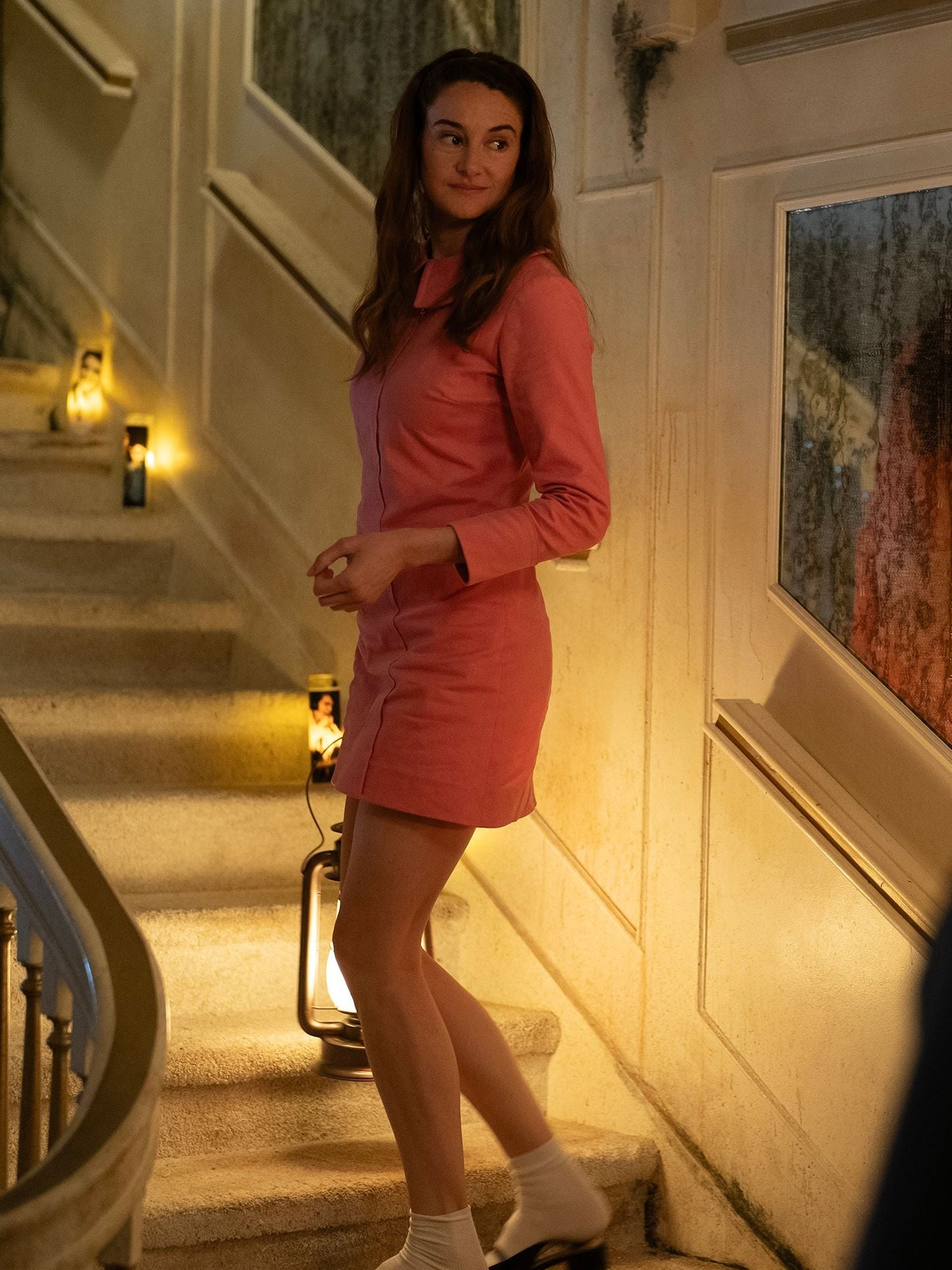

Annie (Shailene Woodley) in the Priscilla dress for "Paradise" season two.
Hulu
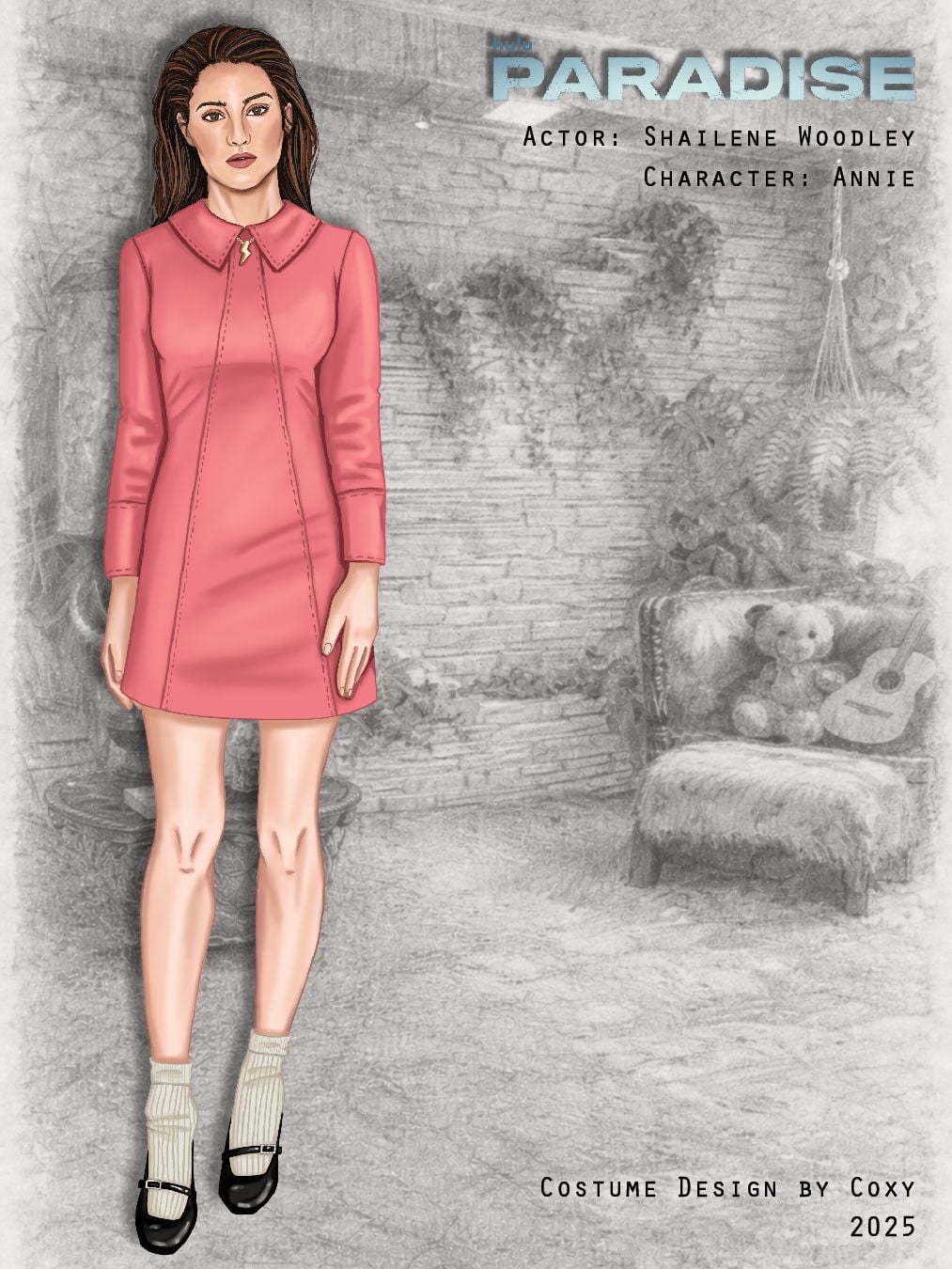

Coxy's sketch of Annie's (Shailene Woodley) Priscilla dress for "Paradise" season two.
Coxy
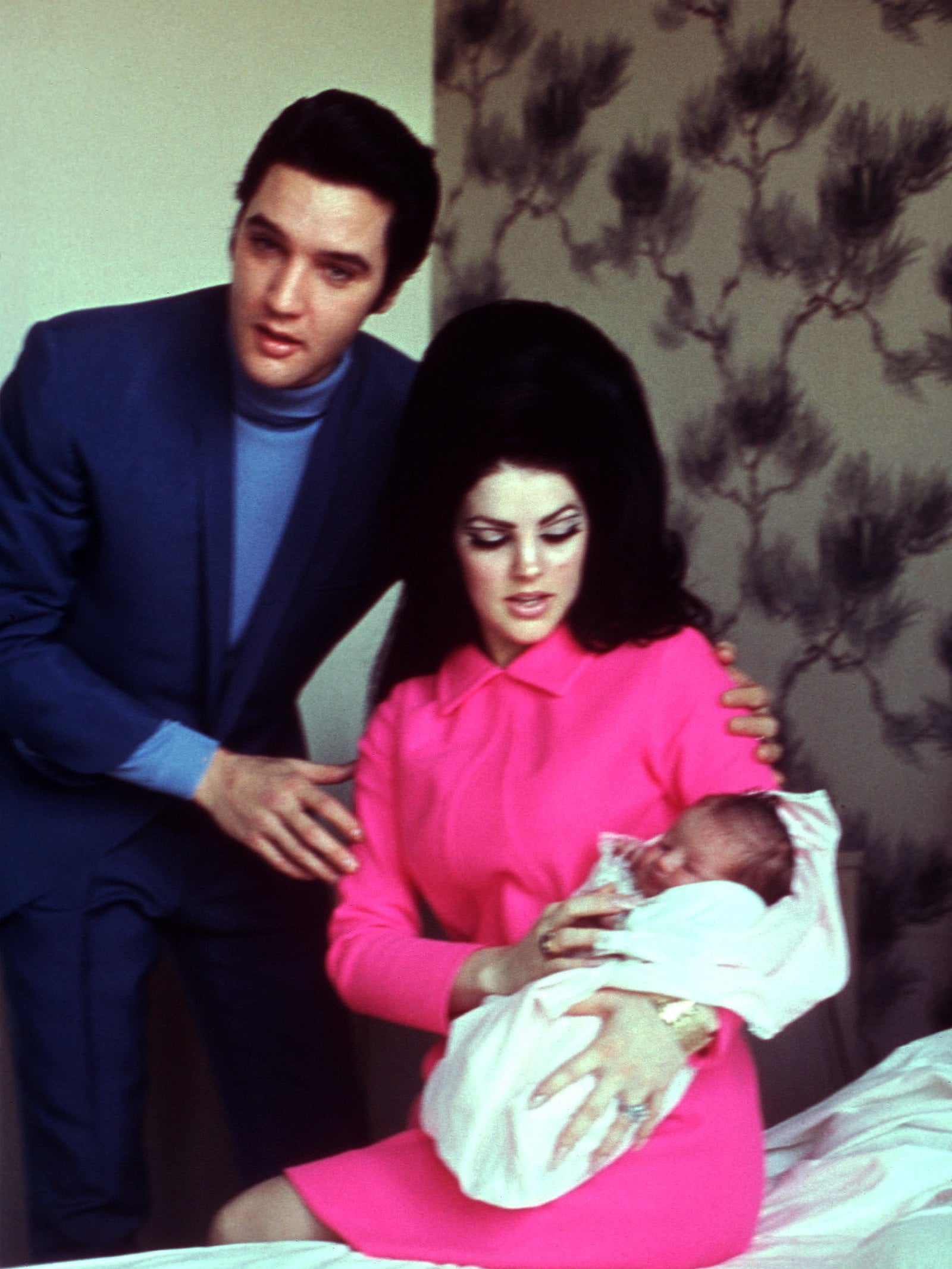

Elvis and Priscilla Presley in 1968.
Getty Images
Annie (Shailene Woodley) in the Priscilla dress for "Paradise" season two.
Hulu
Coxy's sketch of Annie's (Shailene Woodley) Priscilla dress for "Paradise" season two.
Coxy
Elvis and Priscilla Presley in 1968.
Getty Images
Later, as her body grows to accommodate her baby bump, Annie is seen borrowing more from “Elvis’s side of the closet”—jeans, sweaters, and she also wears a puffer jacket Coxy imagines was passed down from Link. These outfits, worn as she ventures out of the safety of Graceland reflect her instinct to protect herself. “It’s all about shielding for her,” says Coxy. “Her choice then becomes more what's practical rather than what's cute.”
Meanwhile, for characters like Link and his gang, their patched vests and oil-streaked pants narrating their endless travel. “They had to be like very aged, very dirty, very, very lived in,” Coxy says. Praising her aging and dyeing team who carefully planed each and every tear, hole, and scuff, she points out that “every single piece—with the exception of what’s worn by the billionaires in the bunker—had to be treated somehow.” That was especially the case for the young survivors that Xavier encounters—a gang of kids who Coxy imagined were on a bus heading to a baseball game when the apocalypse hit—whose once-bright and colorful wardrobes had to be diluted down to reflect three years of dirt build-up. “Sometimes we used an acid wash to fade colors, or sprayed over with paint to keep the brightness underneath,” she says. That balance—surviving but still clinging to vibrancy—defines this new world.
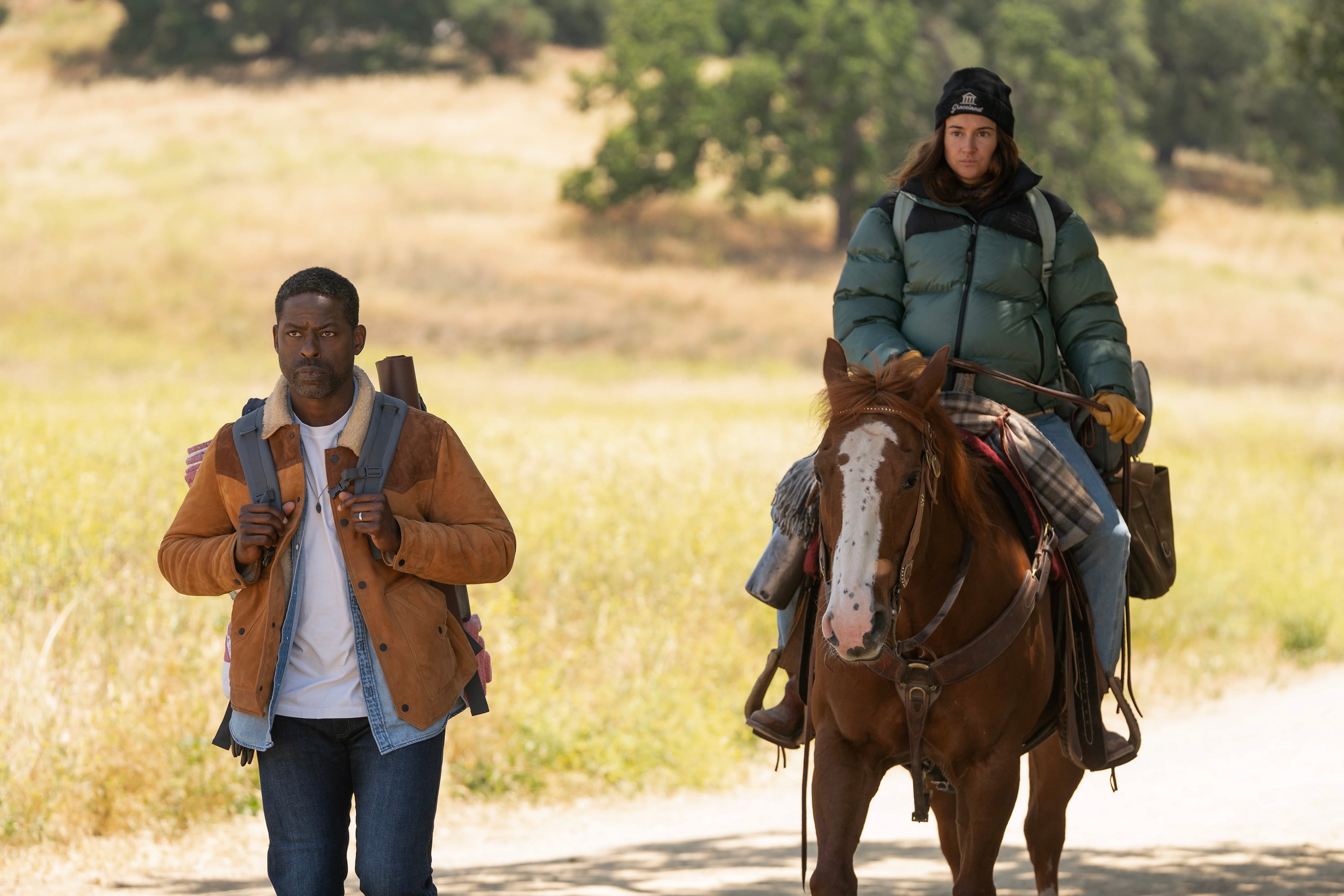

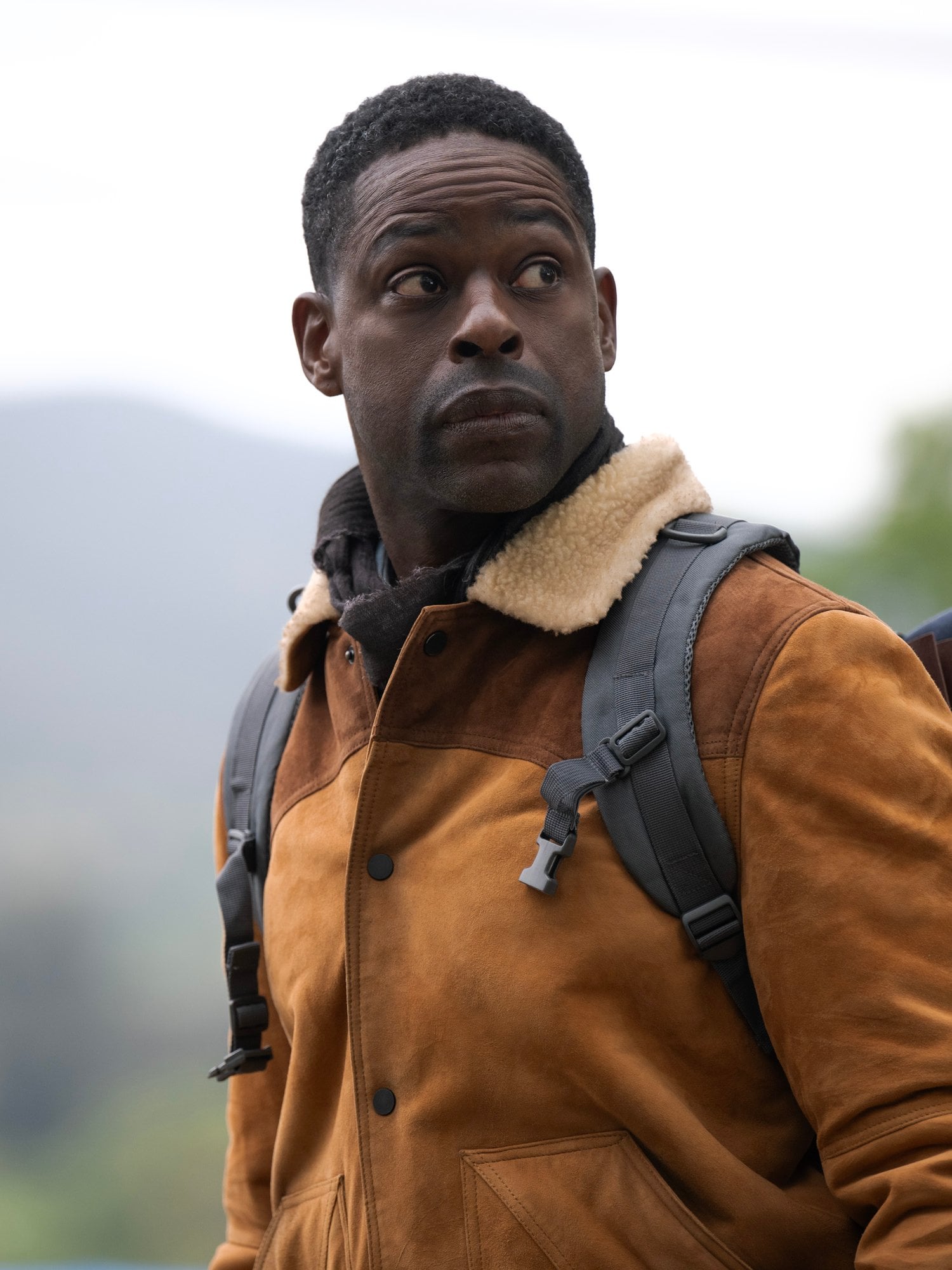
Sterling K. Brown and Shailene Woodley in "Paradise" season two.
Hulu
Xavier’s wife Teri (Enuka Okuma), meanwhile, has been living her own version of survival in Atlanta. As a mycologist (a special kind of scientist that studies fungi) visiting the city for a conference Coxy chose for Teri’s ‘Day One’ outfit a smart-casual uniform of sneakers, wide-leg jeans and a blazer over a blouse. “She had a suitcase for ten days when the day hit, and that’s what she’s surviving with for the next three years.” Her first look is “practical and understated,” and over time she retains a slight “academic vibe,” Coxy says, but incorporates a survivalist edge in more durable boots, belted pants, and plaid shirts.
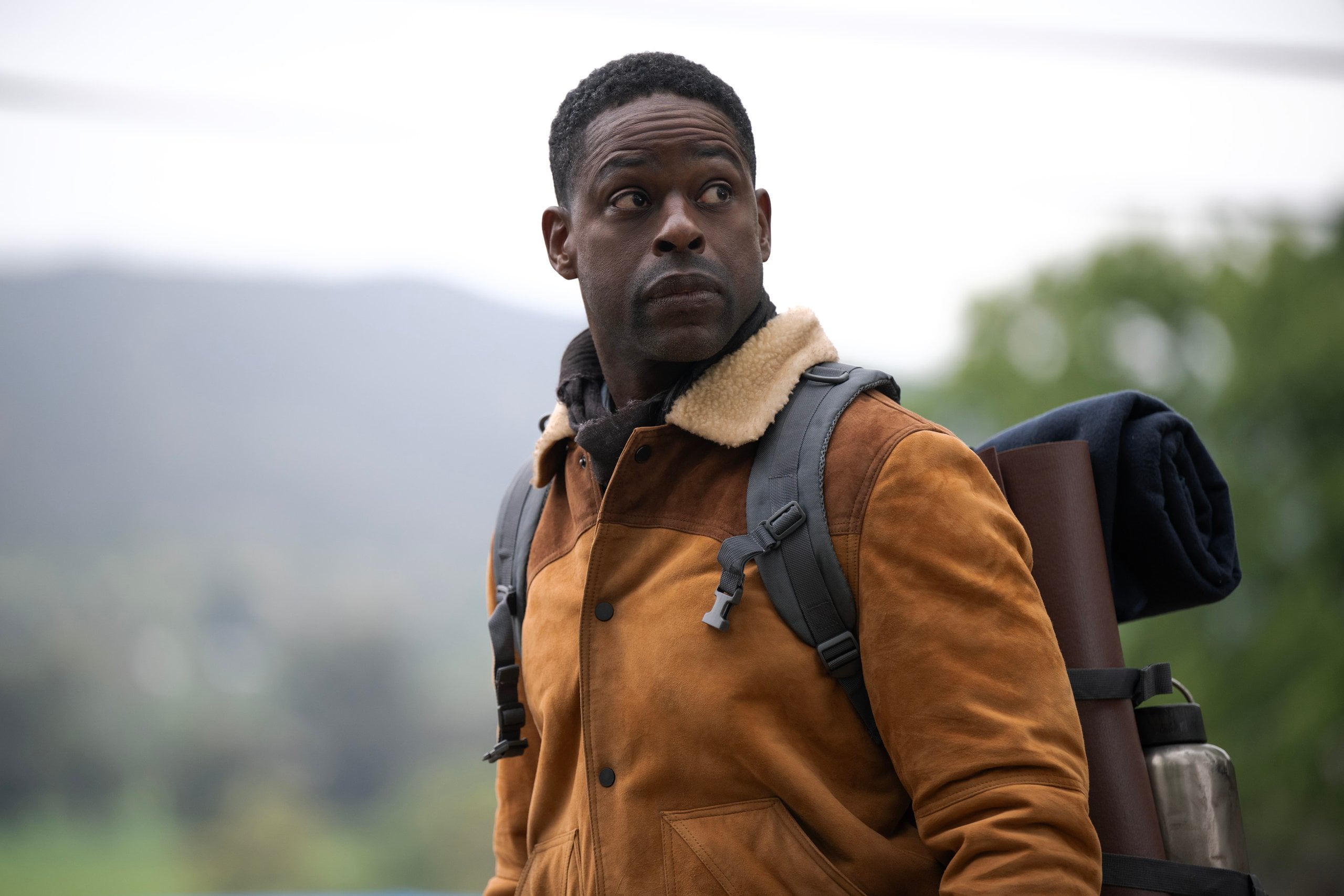
As for Xavier (Sterling K. Brown), for much of the show’s first season, he was defined by black‑on‑black uniform—a visual shorthand for life in the secret service. In contrast, for his season two odyssey across what’s left of America to find his wife color an texture start to seep back into his costuming. “The wardrobe follows his arc,” Coxy says. “Those kids steal everything from him—literally down to what he was wearing that day. From then on, he’s just surviving like everyone else.” Each new outfit tells the story of a stop along his journey. In Graceland, he inherits traces of Elvis: a tan suede jacket modeled after a photograph of the King on horseback. “That jacket was a nod to the Elvis archives,” Coxy explains. “We wanted something that felt like it could’ve come straight from that era—a ‘70s riding jacket, soft and textured, but practical enough for a man on the move.”
From there, Xavier adapts to the communities he encounters. “He borrows, more than he adopts, the wardrobe of every world he passes through,” says Coxy. “When he’s with Annie, you feel the Graceland influence” with ‘70s-style pieces from Presley’s imagined wardrobe. Later everything shifts to rural America: workwear, sturdy jeans and a waxed Barbour‑style jacket that’s seen years of use and was a gift, Coxy imagines, from the rural family who helps him recover.
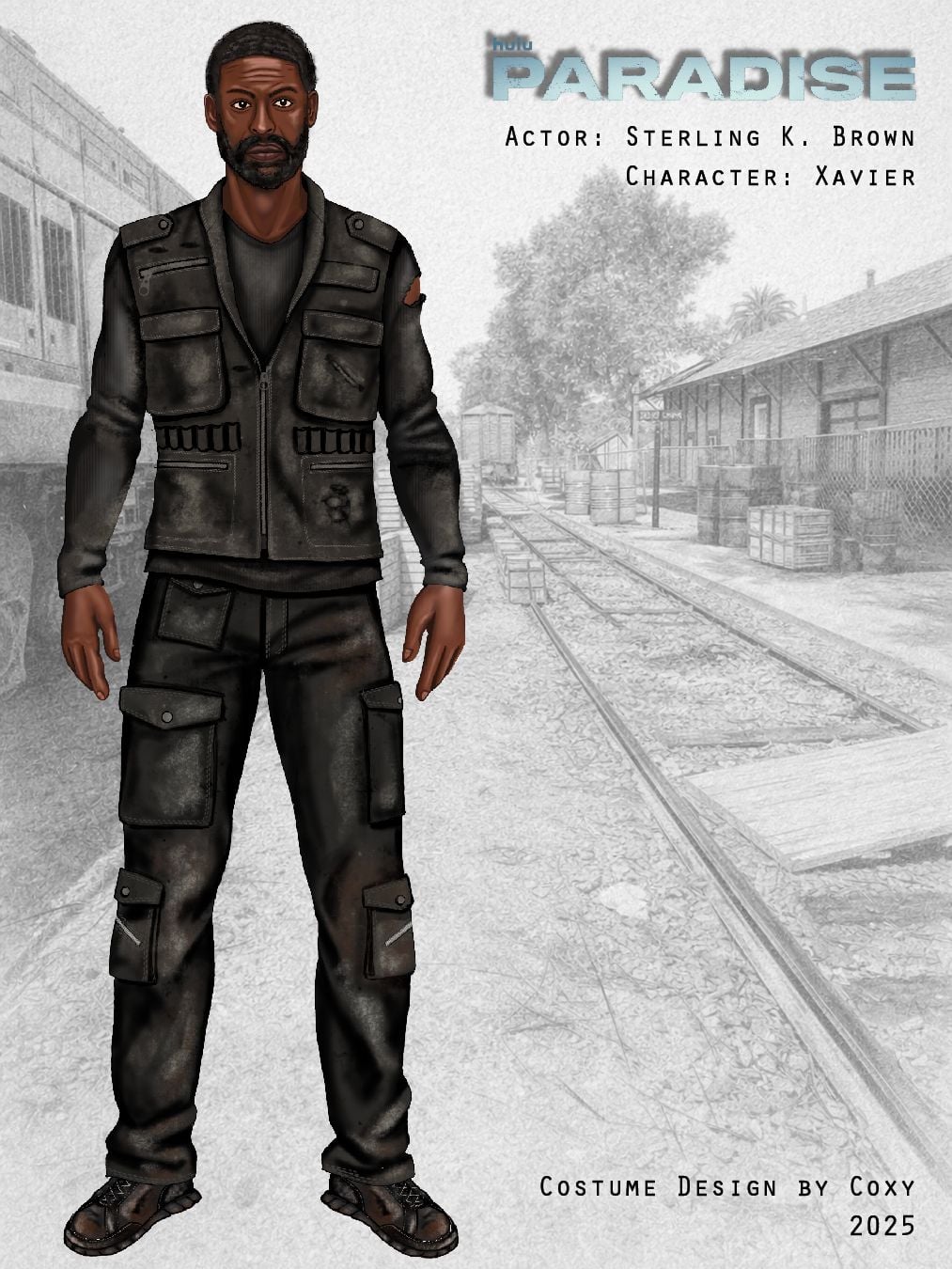

Coxy's sketch of Xavier's (Sterling K. Brown) costume for the finale of "Paradise" season two.
Coxy
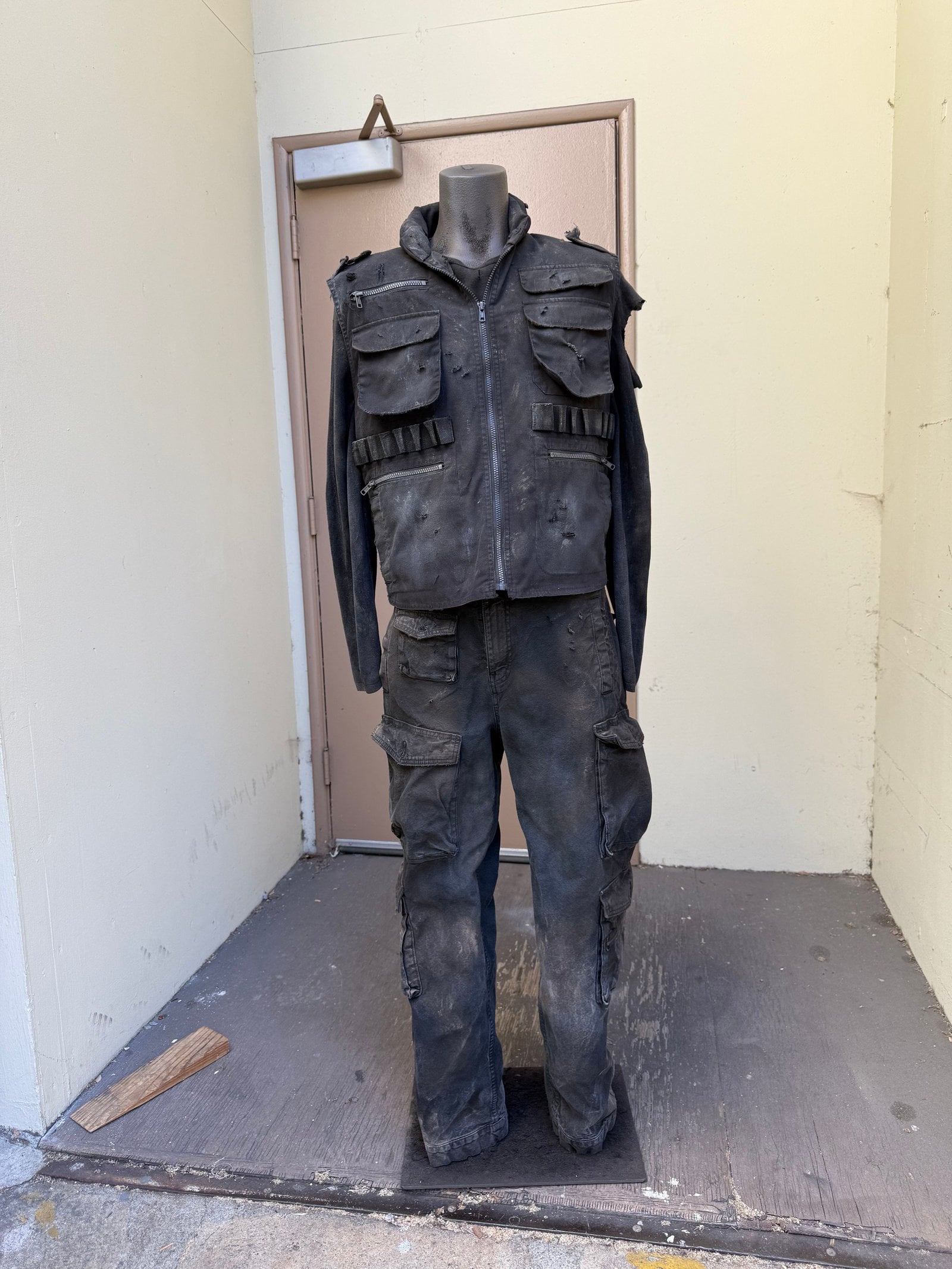

Xavier's season two finale costume on a mannequin.
Coxy
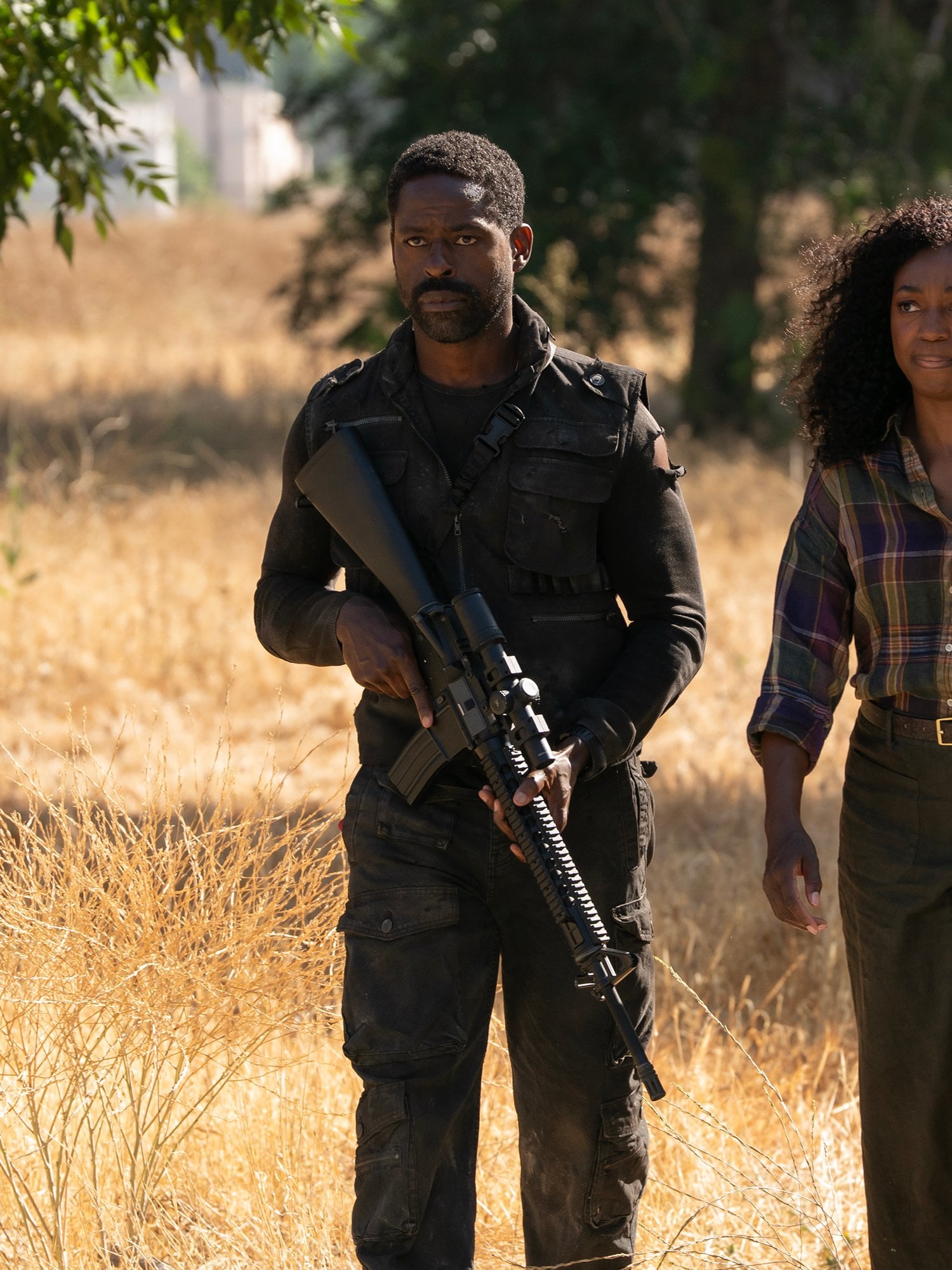

Xavier (Sterling K. Brown) in the finale of "Paradise" season two.
Hulu
Coxy's sketch of Xavier's (Sterling K. Brown) costume for the finale of "Paradise" season two.
Coxy
Xavier's season two finale costume on a mannequin.
Coxy
Xavier (Sterling K. Brown) in the finale of "Paradise" season two.
Hulu
Mid‑season, when Xavier gets closer to reaching Terri, the palette darkens again. “He goes back into action‑hero mode,” Coxy explains. In one sequence set at the swap market, he picks up a vest loaded with compartments, reflecting that regained precision and purpose. “He’s building a bomb, he’s sneaking onto the train—so he needs pockets and stuff where he can put the radio, the knife, the wire—something practical that helps him.” The return of this more functional silhouette reflected a regained precision and purpose. In the finale, Coxy brings Xavier “back to black” in a monochromatic look. The choice, she explains, visually reconnects him to the controlled world he once inhabited.
Conversely, inside the bunker, color drains from the frame as authority tightens. “It becomes more authoritarian,” Coxy says. “The uniforms of the people in control get upgraded—they’re more strict an it becomes very military.” Among the characters, that change is clearest in a trio of powerful women—Nicole Robinsn (Krys Marshall), a secret service agent who was closest to the late president, Samantha "Sinatra" Redmond (Julianne Nicholson), the richest woman in the bunker, and Jane Driscoll (Nicole Brydon Bloom), a ruthless member of the president’s security detail. “While Robinson’s been demoted, Jane has been upgraded. Her suits have that little bit of an androgynous cut—masculine but sexy.” Robinson’s, on the other hand, has her wardrobe “downplayed” with simpler items. Sinatra’s transformation moves in a completely different direction. “In season two we really wanted to show her humanity,” says Coxy. “We started using softer fabrics—cashmere, flowy silks—so that vulnerability would come out more.”
For Coxy, designing “Paradise” Season 2 was about connecting two realities — the bunker’s controlled mimicry of civilization and the chaotic, lived-in true world outside of it. She says the creator of the show, Dan Fogelman, has always “said this story is like a puzzle.” You’re given the pieces, but not the picture and slowly, as you put them together, the image forms. With season three already in production and slated to be the show’s final chapter, Coxy will get to complete that visual puzzle herself.